Showing posts with label multilevel life. Show all posts

Tuesday, December 10, 2019

God is here now, ready to help us -- a reason for Hope!

As a Scientist I believe in GOD, and a GOD who is right here ready to help us all if we simply turn and tune in and ask for help.   There, I said it, and put my career in Science on the line.


But, I put the word GOD in all capitals because I'm using that word in an uncommon sense, and need to keep reminding my readers that I am doing that.   In today's language,  I am talking about God-2.0,  a new version of God, like a new, improved version of a video game or App.   And there, I said it, so now I have also offended and outraged most Religious communities.

I'm losing friends and "Likes" and followers pretty fast here.    But I press onward, undaunted.


I want to address this post to the people who made it this far in reading it -- those who are willing to believe that our context, our universe on Earth,   is alive, awake, aware of us,  and at least partially responsive to our behaviors, actions, and words.   Maybe it's not Jupiter, or Thor, or some old white guy with a long beard on a throne in the sky, but there is definitely something going on here that rises above simply nature or even a larger term "Nature". 


And this is important because whatever is going on here, I believe,  interacts with us heavily in everything we do and to ignore it is to completely misunderstand why some things we do fail and why others succeed,  and to miss out on opportunities to succeed with way less effort and much greater impact in our daily lives.     We are immersed in and swimming in a sea of "tough love" -- it is not our servant to tap into and order about like some Genie in a bottle or some mystical loving parent, though it can "come through for us" and give us things that we would never achieve unaided.  It also is "tough" because there are some facts, rules, guidelines, restrictions on what sort of things we can get assistance on. 


We have to live by its rules, not expect it to live by ours.  This is no different from learning to live with the Law of Gravity -- it just is a fact we can like, hate, believe in, deny it, but regardless it will "rule" our lives all the same.    We all understand Gravity.   There is no "magic" involved,  just higher mathematics which, fortunately, we can be content to let other people understand.  This is just the way things are.   It is no big deal.    We can adjust to it and live with it.

So we all accept that there are things-like-Gravity,   part of the structural design of the world we live in, that we just have to live with.   A good question, and one that we never really articulate and ask out loud in school is

"How many more things like Gravity are there that we need to know about?"


Very much like the "Artificial Life" that I described in my last post here,  the definition of the term keeps changing as we learn more and more,  as it should.  After all we started with a very weak notion of what Artificial Life could be, and it truly needed updating over time.

Sadly,  just suggesting that we raise the question of whether we have this concept,  the meaning of the word "God" as correct and nuanced as possible, and as helpfully defined as possible,  raises a firestorm of heated outrage from all sides - Science, Religion,  and Atheism!   It is discouraging and I must digress for a moment to reflect upon why that is.

In fact, this digression takes up the rest of this post and I have to defer what I was actually trying to point to to my next post in order to keep this reasonably short and coherent.


Over the last 5000 years, as society has evolved, we learned more about the world around us. We added new concepts to our thinking, and refined old ones.   That is a normal and natural process,  which continues at a dizzying pace today, and we need more of it. 

It seems there are three distinct kinds of "facts" that behave quite differently when we try to update them in our minds and in society.  

There are neutral facts that no one cares if we change;  there are socially-connected facts that rock the boat somewhat if changed, but in a tolerable way;  and there are deeply-rooted-beliefs that set the boat on fire and overturn it if changed, and which trigger violent response, even death,  if even challenged, let alone changed.

No one ever seems to mention this or teach it, but it's a very useful distinction to learn.

So long as Scientists retreated from society and focused on neutral facts, like "momentum" they could play happily and no one really noticed or cared, unless maybe a cool documentary on the Discovery Channel came along to share.  Most of the so-called STEM subjects are in this category, and it is also termed "hard science" ,  a misnomer if there ever was one.


Socially-connected-facts are things like Psychology or Sociology or Economics or, surprise,  Geology and Astronomy.    Groups of people have set up camp around certain exact meanings of these facts,  and become agitated if someone rocks the boat.   The camps take on shape and names and become things like the "Chicago School of Economics".    Groups argue often heatedly about who has the better understanding and meaning of the same words.  But in general no one actually dies.


Deeply-rooted-beliefs, as I mentioned above, set the boat on fire and capsize it if challenged or changed.   Not just small camps, but entire nations or cultures argue heatedly over who is right and often are quite willing to go to war, killing or being killed in great numbers, to protect their own understanding of certain words and concepts.    Protestants go to war with Catholics in Ireland.  Sunni Muslims go to war with Shiites in most of the Middle East.   Christian Crusaders invade and attack all of Islamic civilization in the Middle Ages.    Scientists like Galileo, suggesting the Earth is not in fact the center of the solar system,  risked death if they did not recant.


But these deeply-rooted-beliefs are not just about religion, or culture, or the role of women in society, or differences between races and racial identity.    So called Scientists also become emotionally attached to and even ardent defenders of certain understandings.    Revolutions and changes in "paradigms" such as Quantum Mechanics,  Plate Tectonics, or the nature of "disease" ( invisible tiny organisms living inside us? Really?!!!) were fiercely denounced and resisted and proponents of new ideas excluded from funding or mocked and shunned.

Heck, even the guy Ignaz Semmelweis who realized that women were dying in childbirth in the hospital because surgeons were not washing their hands, and tried to tell them that,  was driven out of practice and put in a mental institution where he quickly died. 
There are things that some people do not want to hear.


Anyway,  where all this was going is that the subject of the nature of GOD is one of those live-wire, hot-button topics that typically causes much heat and no light to emerge from a discussion or attempt to study and grasp the kernel of truth out of the shell of attached meanings of old.

I've spent most of my life believing that there is, indeed, something, some kernel of Truth that matters to me,   buried in and tangled up inside this bundle of meanings attached to the word GOD.  Yes, most of the simplistic meanings are just laughable and can be dismissed out of hand.  There is no dude in a white robe sitting on a throne running or ruining our lives.


But on the other hand, there are some aspects of reality that are as important as the Law of Gravity,  but equally invisible, that still change the outcome of what we try to do as surely as they change the trajectory of a ball we throw upwards.

It is just plain wrong not to try to investigate, in a clear-headed, skeptical but curious manner,  what those structural laws and design features of the world around us might be.  In my book, that is precisely what Science is all about and we should not be deterred by skulls on stakes and big signs that say "Forbidden territory -- all hope abandon ye who enter here!"

Heck with that.  Let's go see what is over there on the other side of the police tape.


To be continued in my next post!


Saturday, November 10, 2007

Survival of the selfless


"The consequences of regarding evolution as a multilevel process, with higher-level selection often overriding lower-level selection, are profound." This under-statement is in the latest issue of New Scientist, in a must-read piece titled "Survival of the selfless", by sociobiologists David Sloan Wilson and Edward O. Wilson. (New Scientist , 3 Nov 2007).

Indeed. Since I've been presenting the case for multi-level co-evolution in my weblogs for the last 2 years, I am ecstatic to see some big names in the field take the same position.

This furor is about whether it is "genes" that evolve, or "individuals" or groups of individuals such as tribes or species. Views were and are still held by many otherwise rational scientists with religious fervor in the worst sense, and arouse equal vehemence when challenged, akin to that between creationists and evolution-supporters.

This matters because higher level groups may have a whole different "fitness" measure than individuals, and while individuals or genes might evolve faster by being "selfish", the whole society of individuals might evolve faster if everyone was cooperative and altruistic. This battle continues to rage today, and is a core issue in whether "competition" and "free markets" are a good idea or not. So it is tangled with social ramifications, just like all science ultimately is.

This is also a core question in whether a "Theory X" company, driven by internal competition between managers, can ultimately be out-performed by a "Theory Y" company, like Toyota, driven by massive internal cooperation. A lot of egos are at risk of being bruised. A lot of justification for public policy is at risk of being overturned. It's a big deal.

Well, which is it? Do individuals evolve by being better at beating each other, or do groups of individuals dominate by being better at collaboration?

Peeking ahead, of course, I usually argue that "or" is a bad concept, once feedback is involved, and the right solution to look at usually involves "and" and "all of the above, simultaneously, interacting." But, "all of the above, interacting with feedback" was way beyond anyone's ability to compute or analyze, and not an attractive model for most researchers or grant writers.

Well, back to this article. In the face of enormous opposition, and tacking a consensus in the field that group-level evolution is a dead concept, they really settle for the weak claim that "we cannot rule out group-level selection."

Hmm. What's this all about? The concept is fascinating, and the sociology of science is equally fascinating here. The Wilsons ask "Why was group selection rejected so decisively [ in the 1960's ] ?" What a great question in how Science works!

Now, I should note that I'm one of the casualties of what seems a similar disastrous and mistaken turn of a field, namely Artificial Intelligence ("AI"). I got hooked by a course at
Cornell in 1965, taught by Professor Frank Rosenblatt, titled "Learning and Self Reproducing Machines".He and his lab had developed a "perceptron", a maze of switches and wires that connected up to a 20x20 grid of 400 photocells, on which letters of the alphabet were projected.

The perceptron, a model of human vision and learning, was slowly learning to tell the letters apart and identify them. At the time, this was astounding, and many scientists confidently argued that this could never be done. Later, of course, Kurzweil and others carried this technology forward and made OCR text-scanners that are now about 99.5% accurate or better and can read license-plates at an angle from a speeding car. But, in 1965, telling "A" from "B" was a big deal, especially if the "A" wasn't always exactly straight up and down, or in the same place on the grid.

The perceptron's insides were a network of wires and "nodes", a model of our brain's neurons, where the total strength of signal coming into each node was added up, multiplied by some factor, and either triggered or didn't trigger an outgoing signal to the next layer. The system learned by changing these multiplicative factors, searching for some set of them that would ultimately trigger the highest level "A" node when an A was projected on its primitive retina, and trigger at "B" when a B was projected, etc.

Then, the field was devastated by a very authoritative and persuasive paper, ultimately retracted, by highly regarded MIT professor Marvin Minsky that this approach "could never work." Funding dried up, and researchers moved on to other projects. Labs closed.

It took over a decade until somone finally figured out that Minsky had simply proven that a two-level neural net had irrecoverable gaps in its logic, and was not "complete". What he failed to look at, or see, was that these gaps went away when you got to three-levels or more.

Wikipedia has this quote:
Its proof that perceptrons can not solve even some simple problems such as XOR caused the virtual disappearance of artificial neural networks from academic research during the 1970s, until researchers could prove that more complex networks are capable of solving these and all functions.
(source: Hassoun, Mohamad H., Fundamentals of Artificial Neural Networks, The MIT Press, 1995. pp. 35-56.)
Oopsie.

Anyway, it appears to this observer that a similar phenomenon has occurred in socio-biology. Some very persuasive people published papers "debunking" multi-level evolution, well before there was enough computer power to actually simulate it and see what happened. ( In 1978, the mainframe computer I was programming had 4,000 bytes of memory to work with. Not 4 Gig, or 4 Meg, but 4 thousand. Any cell phone today has more than that.)

The social climate at the time made this debunking seem a better idea. World Communism was the mortal enemy of all that was good and holy, threatening "our way or life", justifying huge military expenditures, and anything that suggested communal good or community was more important than individuals was instantly suspect and risked being dragged before the House UnAmerican Activities Committee, where the proponent had to renounce their views or be thrown out of their jobs or locked up as being "unAmerican." Everyone was building bomb-shelters for protection against that day's terror threat.

In addition, religions had held for thousands of years that there was really nothing of importance between man and God, and man was God's noblest creation, so the idea that something larger than humans but smaller than God mattered was suspect dogma. (These days, the evolution of the earth and global warming is in fact dominated by such a larger life-form, "corporations", which have more or less hijacked the role individuals used to play in influencing governmental decisions and policies. But that observation lives in world "A", and discussions of evolution live in world "B", and the two don't talk to each other or trade notes.)

Then, of course, some people didn't like the idea of evolution in any form, and rejected it and most of biology and science based on that view.

So, for many reasons, some good, some not so good, the idea of group evolution as a dominant or even important force was denounced, rejected with emotion, and painted as an example of wrong thinking to be avoided at all costs.

Now, by what the Wilson's say, the whole question is being raised again, this time in a climate with much more powerful computers, where cooperation and collaboration in corporations are not always dirty words, and where the old theories, frankly, didn't explain why there was just so much altruism and goodness in people.

As I say, I'm delighted.

Also, finally, as I've posted on before, finally "feedback" and dynamics are starting to be considered in models, and finally multi-level causality keeps on increasingly showing up in how individuals behave, to the point where the National Institutes of Health and the Institute of Medicine talk about the necessity of using multi-level models to understand social interactions and how the things we see around us, like poverty, are held in place by many subtle but very powerful forces at different levels.

Fascinatingly, this gets us back to what Charles Darwin himself said in The Descent of Man, published in 1871, and the lead sentence in the Wilson's article:

Although a high standard of morality gives but a slight or no advantage to each individual man and his children over the other men of the same tribe ... an advancement in the standard of morality will certainly give an immense advantage to one tribe over another.

The Wilsons say that group evolution, versus individual evolution, doesn't yet explain the observed rise in altruism, although they can computer a visible imact.

Immodestly, I'll suggest that they need, like Minsky, to look at three levels, not two, to see the effect start to dominate.
In fact, all around us, we see corporations trying to survive and be more fit than competition, by pouring resources into internal cooperation and collaboration. So while individuals may continue to follow "greedy algorithms" and seek their own advancement, the corporation is making the playing field non-level and rewarding collaboration as the method of getting ahead personally. In that sense, Corporate policy is serving one role of religion - seeing the larger picture, thinking globally, and then trying to shift the local context so that relatively less visionary individuals, acting locally, will do the right thing if they just follow the rules.

This "think globally, act locally" function is the key role that "unity" has to handle, and it works best if people stop fighting the behaviors and yield and embrace the behaviors instead.

People have to let go of their own ego, "die to themselves" as it were, only to be "reborn" where their ego now includes the other people in the larger village or familiy or corporation they now have committed to belong to. In some sense, they now are just selfish at a whole larger level, as now those villages or corporations or religions or nations start competing, and the whole cycle begins again at a higher level, as they too have to learn that collaboration beats competition hands down in the long run, even if it doesn't seem obvious locally.

This phase transition is one we should be looking for and supporting. It's built so deeply into the fabric of space and time and control loops that it is inevitable and always working in the background, at ever higher levels, simultaneously. At least, that's how I see it.

Of course, that would imply that it won't be long before earth discovers we're just one inhabited planet of millions such planets, and we have to deal with the whole unity/diversity and competition / collaboration thing all over again at an even larger scale and scope.

Which is a model that some people don't like, so this can get emotional again. Still, I think we need to get used to the idea that we are not on top of God's creation, just below Gods ourselves, but maybe quite a few levels lower than that. Earth is not in the center of our galaxy, nor in the center of the universe.

It's a very scary concept to some people, if the world is seen as a place where competition and dog-eat-dog dominates. That belief leads to an imperative to dominate the world, before someone else dominates you. On the other hand, if the world is a place where cooperation and collaboration dominate, then it is a far less scary place, and we should "get with the program."

Already our corporations, internally, are undergoing this transformation. Kicking and screaming, often, but they cannot deny that the Toyota model outshines the GM model.

We need to speed the transition on the level of nations and religions as well, and find that sweet spot where cooperation and collaboration work so much better than competition for dominance and attempts at mutual destruction.

All of those struggles are tied up in this question of the way nature, life, and/or God operate here and what the design principles are that we can rely on to work. The cells in our bodies don't triumph in "beating" each other, but in collaborating with each other. It's a good model, and it's been field tested, and it works.

We should stop fighting it and use it.

Wade


The New Scientist article says of itself:
This is an edited, abridged version of a review in the December issue of The Quarterly Review of Biology. Further reading: D. S. Wilson's book Evolution for Everyone: How Darwin's theory can change the way we think about our lives describes multilevel selection theory for a broad audience. D.O. Wilson and B. Holldobler's forthcoming book The Superorganism analyzes how insect colonies can be seen as products of colony-level selection.

Friday, August 10, 2007

The ladder of kindness

(Above - Photo of World War II poster from diggerhistory.)


There's been a lot in the press in the last few days about immigration and new census findings of where immigrants are living in the US, which is increasingly outside the big cities, not in them.

Robert Putnam discussed some findings related to "diversity", or, more likely, related to recent changes in diversity.

By themselves, ethnic diversity and remixing are generally good things for a species, making the ecology more stable and the species more able to deal with change without breaking.

But, in today's human society, this process is overlaid with another set of processes related to bias, discrimination, fear, and hatred. What's up with that? Where'd that come from? That seems more "man-made" than "natural."

I was struck by a comment in the newspaper USA Today on August 9th, in a headline story "Hispanic growth extends eastward -- Areas unfamiliar with diversity" by Haya El Nasser and Brad Heath.

The lead was this:
Rapidly growing numbers of Hispanics are fanning out across the eastern half of the USA and settling in rural and suburban counties far from traditional immigrant strongholds, according to Census numbers released Thursday.

The increases in areas that experienced little diversity until this decade intensify the uproar over immigration. Forty-one states have enacted 171 laws this year aimed at illegal immigrants. About 100 communities have proposed similar ordinances; 40 have been enacted.
Again, we see a transition in those two paragraphs from changes in migration in the US, yawn, not the sort of news most people read about in a subscription to American Demographics. But then the article turns a corner and moves on to "uproar over immigration" as opposed to, say, delight in having new blood, new faces, new stories and music and food and dance s instead of the same old stuff "your parents had." Americans think of themselves as being innovative and discarding the past and seeking a new modern future - so, again, what's with the "uproar." This is surprising and demands further explanation.

Then the second paragraph changes the tone a third time and moves on to "laws aimed at illegal immigrants." Now suddenly we're no longer talking about boring internal migrations, or arrival of new neighbors, but we're talking about some sort of criminal activity associated with that. Again, "what up?"

The third paragraph drives in the spike deeper and goes for the jugular:
"We're seeing new immigrant minorities coming in to areas that haven't had very much minority populations or immigrant populations," says William Frey, demographer at the Brookings Institution. "It put immigration on the front burner politically. It scared a lot of people."
Now we have the term "Hispanic" associated with "illegal" and "scary", and the further implication that "everyone shares those views" and "it's time to panic! Hide the children and the silver! Man the barricades! Lock and load!"

So, if I said "there are some new Canadians moving in next door", that wouldn't have the same ring at all, would it? So why is the term "Hispanic" being emotionally charged up and poisoned this way? I know some people who are "Hispanic" and they seemed, you know, pretty much like you and me, and pretty human -- more like Catherine Zeta-Jones than something else.

So, I wheel out the multi-level model I've been working on in this weblog, and see what that "macroscope" reveals. It's interesting.

First, the anger and hostility and fear seem to be coming top-down, not bottom-up. In fact, at lower levels of the great hierarchy of life on Earth, we see higher levels of cooperative behavior taking place, amid the noise. The cells in our bodies work together, mostly, and we even get along stunningly well with other species who inhabit our gut and even our cells (thinking of mitachondria.) We get along fine with most bacteria who protect us from the few bad apples, and risk or health when we kill off our normal intestinal population of other species or the normal species that live on our skin, blocking bad guys like fungus from getting a foothold.

And, at the human level, we get along pretty well. Despite what is shown on Television, I don't actually see people around me at work murder each other on a daily basis. Violence is the exception, not the rule. Individual doctors are really nice people.

But as we get to higher levels of meta-life's players, things get increasingly dark. Corporations are very often not nice to each other. Although they do seek stability and permanent working relationships, inter-corporate violence and even cannibalism (disassembly for the parts) are common. While the individuals who make up a health system are really nice, caring people, the overall thing, the "system" often behaves in a cold, uncaring, even predatory fashion as seen by patients.

And Nations and Cultures, it seems, are often even nastier to each other, with random violence, murder, and conquest often dominating their lives on their scale. Cooperation between nations is possible, but rather fragile and volatile.

I'm continuing my approach of viewing each of these levels of organization of Life as having a "life of its own" -- which is a crucial element in this story. So, it is possible, even likely, that individuals in a larger organization have one agenda and view, while the entire organization, taken as whole, has a completely different agenda and view.

Further, the agenda of the larger structure is often completely invisible to those who are part of it. Doctors and nurses may have a hard time realizing how cold and uncaring the whole "system" level is as viewed and experienced by patients, for example. They experience it a different way from inside it.

Similarly, the whole of the USA is populated, mostly, by decent, caring people who love their children, enjoy sports and socializing, and mostly do not (despite TV) spend all day being either total jerks or killing each other.
Despite that, the larger entity, the USA, as a whole, as viewed and experienced by outsiders, is just like the health system -- it is far colder, more hostile, and more predatory than those inside it can directly perceive.
So, for that matter, are all the other "country" level organizations and Meta-life-forms - I don't mean to single out the USA.

So, some of the events going on around us are things that our cells are doing; some are things that people are doing; some are things that corporations are doing; some are things that nations and cultures are doing; and some are things that the planet as a whole is doing, etc. The time scales get successively longer as you move up -- cells live a world where life is measured in milliseconds, people in a world of hours and days, corporations in a world of "quarters", and nations and cultures in a world of years, decades, centuries, or millenia for many of them, aside from new kids on the block like the USA that are recent arrivals.

And, let me emphasize that the things larger systems do are only partly the actions of their executive level. We are seeing a lot of news lately that as humans, our "lower brains" and bodies and gut actually have a life of their own and make a lot of decisions for "us" that we, at best, run around after trying to make sense of and "take credit for". We are post-hoc rationalizing creatures, not rational ones, in terms of "our" actions.

Ditto for corporations. The CEO's may get paid big bucks, huge bucks in the USA, but in reality often their company has "a mind of its own" and is "damned nearly unmanageable."

Ditto for nations. The President and Congress may appear, to mere mortals, to "be in charge" but if you ask the Presidents if they "run things" they'd laugh hysterically at how little control of events they actually have. Again, events run on their own, "almost" with a "mind of their own" and our "leaders" are largely observers who run around trying to take credit for what seems to be coming out right and finding someone to blame for what seems to be coming out wrong.

That said, let's get back to this puzzle of discrimination and fear about "immigrants."

What seems to happen is that, on a national level, "the nation" (versus people) decides that it wants to take something from some other "nation". It could be land, natural resources, or slave labor. This activity is not "cool", and humans are, mostly, not cruel and violent people, and don't see themselves as such. So, to get the desired action from the people a new perception has to get created, that the nation, and people, who are "in the way", are actually bad people. In fact, they are terrible people. Monsters. Worse than monsters. Sub-human. Dangerously sub-human predators like spiders or poisonous snakes who are a threat to our children and, who, oh look, have no "human" rights because they are no longer "human."

So, myths are developed, often with the encouragement and assistance of a government, and generally along the path of least resistance - emotions that humans already have that can be mobilized to this end.

In wartime, this activity is extremely systematic and we pay big bucks to people to develop "propaganda" to deliver this message. Here's an example from diggerhistory.


(above picture from www.teacheroz.com - from World War II.)

Curiously, some of these images fade out from view, and some persist. Lately, most people don't think of the Japanese, or Germans, or American Indians (Native Americans) as brutal savage flesh-eating sub-life monsters.

On the other hand, some images do persist or grow. The USA was very active at enslaving and exploiting the people of Africa, not a pretty image to have in the mind, and for many it has been softened by debasing that continent as a whole, and those people in particular. They have been demonized, dehumanized, and blamed for their victimization which is seen as "deserved."

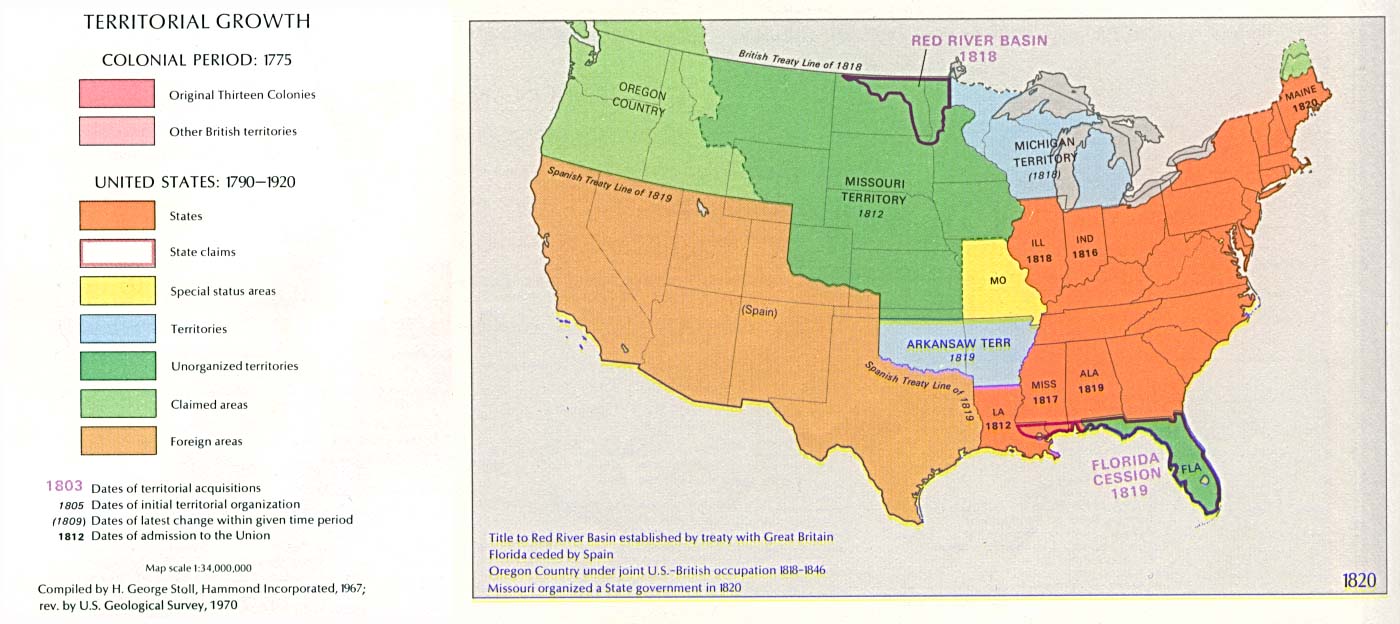
The USA also wanted a large chunk of land west of the Mississippi that was controlled by Spain and/or Mexico. This needed to be taken at gunpoint since Mexico didn't want to give up its land any more than the USA would be willing today to sell California back to Mexico.

(click on map to zoom. The whole southwest needed to be "taken" to meet the USA's goal of reaching both oceans.
http://www.lib.utexas.edu/maps/united_states/us_terr_1820.jpg )

As well, large sections of Central and South American "needed" by be exploited by the USA, goods taken, and opposition forces jailed or killed. That wasn't a very pretty picture, and, again, the population was demonized, dehumanized, and a new image painted for Americans of Hispanics and Mexicans as backwards, deservedly poor, lazy, illegal, criminal, interested in mooching, etc.

While people participated in creating that myth, to a large extent it was a system action that used this myth to justify what it wanted to do anyway -- take the land and exploit the people.

So, getting normative here, I think it's our job to recognize when groups are becoming targets of such increasing myths, and dispel them before they grow so strong that violent action results. It's important to realize that these thoughts are not our own thoughts or experience, but are being selectively reverberated by "systems effects."

As with the poverty ghetto, these thoughts can be caught up in a self-reinforcing positive feedback loop, that begins to "pile on" confirming evidence to justify that view, while conveniently and increasingly ignoring contrary evidence, until even our own personal entire experience becomes doubted. At that point, we fall into enslaving populations (as with African Americans) or exterminating them wholesale (as the Germans were doing to the Jews.)

And, again, as with ghetto formation, this effect appears to be a self-constructing web that requires no "spider". Certainly, some politicos will "ride this" and pour gasoline on the flames if they think it will bring them personal success, but that is more a reinforcing symptom than a "cause." Politicians couldn't amplify this effect if it wasn't already in motion.

Our job is to debunk such myths, recognize that these are someone else's thoughts, not our own, and return to sanity and common sense and trusting our own experience in the period prior to the call going out to rally the troops against the menacing advancing horde of Hispanics who plan to eat our children. It's too bad the broad-brush category even exists to justify a "them" versus "us" lumping -- without it we'd say - Oh, Mary and Rafael and their kids? What a nice family! Let's have them over for a barbecue on Saturday and maybe we can play some soccer or baseball or something.


xx

Tuesday, July 31, 2007

Subliminal and subconsious systems

Then again, we can look "downward" or "within" and see systems with "minds of their own" that control a lot we thought we controlled.

Here's the lead of an article from today's NY Times.

July 31, 2007

Who’s Minding the Mind?

In a recent experiment, psychologists at Yale altered people’s judgments of a stranger by handing them a cup of coffee.

The study participants, college students, had no idea that their social instincts were being deliberately manipulated. On the way to the laboratory, they had bumped into a laboratory assistant, who was holding textbooks, a clipboard, papers and a cup of hot or iced coffee — and asked for a hand with the cup.

That was all it took: The students who held a cup of iced coffee rated a hypothetical person they later read about as being much colder, less social and more selfish than did their fellow students, who had momentarily held a cup of hot java.

Findings like this one, as improbable as they seem, have poured forth in psychological research over the last few years. New studies have found that people tidy up more thoroughly when there’s a faint tang of cleaning liquid in the air; they become more competitive if there’s a briefcase in sight, or more cooperative if they glimpse words like “dependable” and “support” — all without being aware of the change, or what prompted it.

--- wade