Thursday, August 16, 2007

Why do smart people do dumb things - Countrywide


Countrywide Financial Corporation is the latest case study of how smart people do dumb things. What is surprising, in retrospect, is that failures of this magnitude are not studied with the zeal that commercial airline accidents are studied. After all, probably as many people are hurt or killed by the indirect effects.

Still, are we learning from experience? Or simply repeating the same mistake over and over? Airliners use cockpit simulators to train pilots to avoid errors -- what do we need for CEO's and average home buyers?

What comes to mind is a short poem by Shel Silverstein " The Slithagadee. I can find many variations of it on-line, so I'll just quote it as I remember it:

The Slithagadee.

Oh, the Slithergadee
Came out of the sea.
He caught all the others,
But he won’t catch me.

No, you won’t catch me,
You old Slithergadee.
You caught the others,
But you wo...

—Shel Silverstein

Anyway, here's a few facts on Countrywide Financial from today's LA Times. My excerpts focus on two things:
  1. the psychology of feeding frenzy and how, as with "only a foot" of water on the road, you can find your car swept away, and
  2. How "systems" effects mean everything affects everything else -- there is no immunity.

Credit crunch imperils lender

Worries grow about Countrywide's ability to borrow -- and even a possible bankruptcy.

By E. Scott Reckard and Annette Haddad
Los Angeles Times Writers

August 16, 2007
[Excerpts]

Angelo Mozilo, chief executive of Countrywide Financial Corp., has been fond of saying that the company became America'sNo. 1 mortgage lender by being smarter than the competition.

In a harangue to Wall Street analysts early last year, the combative Mozilo denounced upstarts for shoveling out too many loans, too easily, to too many people with bad credit, heavy debt and skimpy income.

"I've been doing this for 53 years, and I've never seen that situation sustained," said Mozilo, who co-founded Calabasas-based Countrywide in 1969. "Eventually they gag on it."

Dozens of home lenders have indeed collapsed as defaults have surged on loans made to people with poor credit during the housing boom and as Wall Street has turned off the money tap that funded many of those sub-prime mortgages.

But rather than emerging bigger and stronger as Mozilo predicted, Countrywide -- which made 1 of every 6 home loans in the U.S. in the first half of this year -- now finds itself battling not just its own growing defaults but also a widening credit crunch stemming from the nationwide sub-prime mortgage meltdown.

On Wednesday, the company was said to be having trouble borrowing money on a short-term basis, securities analysts discussed the possibility of a Countrywide bankruptcy and the firm's stock price tumbled 13%, bringing its loss for the year to 50%.

An insolvent Countrywide could also do more damage to the country's already weakened housing market, said Guy Cecala, publisher of Inside Mortgage Finance, a trade publication based in Bethesda, Md.

"It would be a huge shock to the U.S. housing system and the mortgage system as perceived around the world -- and make an already bad situation terrible," Cecala said....

"The problems Countrywide is experiencing has nothing to do with its mortgage business," Cecala said. "By all measures, Countrywide is a well-run, profitable company. What they're finding out is that although they thought they had diversified funding sources, nothing is diversified in a worldwide credit crunch like we're in now."

In 2003, old-fashioned 30-year loans with fixed interest rates and substantial down payments made up about two-thirds of Countrywide's loans, said mortgage executive Bill Dallas, whose Agoura Hills-based sub-prime lender Ownit Mortgage shut down early this year.

By last year, only one-third of Countrywide's loans were of the traditional type, with the rest spread among the more exotic loan variety, Dallas said. He said Mozilo, who had often been quick to criticize rivals for being overly aggressive, had found himself immersed in the same businesses as his competitors.

"Every section of the business that has failed, they're in there big time," Dallas said.

At some branches, managers would buy lunch every day for their staff to keep them at their desks working.

At the height of the boom in 2004 and 2005, it wasn't uncommon for a typical Countrywide loan officer to sell 20 sub-prime loans a week. "It was a feeding frenzy," said one former Countrywide employee who said he joined the company in 2004 and, after six weeks of training, made $6,000 to $8,000 a month. As fast as loans could be signed, they could be sold to investors, according to the former employee, who declined to be identified....

Over the years, Mozilo's pay packages -- $48.1 million in 2006 alone -- ballooned along with his company's fortunes.

Countrywide also bills and collects payments on $1.4 trillion in mortgages for itself and other lenders. What's more, Countrywide is the largest customer for Fannie Mae, the big government-sponsored mortgage buyer. More than one-third of all mortgages sold to Fannie Mae comes from Countrywide.

"The question is, is Countrywide too large to fail? Will the Fed allow it or will it need to step in and bail it out?" Cecala said.

A bailout of Countrywide would make the government's efforts to save automaker Chrysler in the 1970s look puny.

"Countrywide is more important than Chrysler was back then, particularly given the fragile state of the economy and so much tied to housing," Cecala said.

Of course, what's not mentioned is why a healthy company needs to borrow money in the short term to survive. Where did they put all their rainy-day savings from prior profits? Hmm. IT does sound like the "hedge funds" who were so sure of profits that they borrowed against the value of everything they owned and bet it on this "sure thing" -- except the nag broke a leg on the far turn of this track.

If so, this is really no different than the employee who "borrows" $10,000 from the bank till at lunchtime to go bet it on a sure thing and return it by the end of the day and no one will know.

Maybe we need to learn to recognize the typical signs and symptoms of unjustified reliance on ... hot air ... as a basis for business decisions or governmental policy decisions.

What is particularly dangerous, as I've pointed out before, are positive feedback loops, where the "reason" something is becoming more attractive is that "it's becoming more attractive." This phenomenon accounts for some Hollywood fame, where the only reason one can see for why this unremarkable person is famous is that they are famous and it feeds on itself.

That may even be a great strategy to make a buck on as it rises, as long as you stay aware that on any morning the wind may shift and suddenly it is falling just because it is falling, and the spiral up becomes a death spiral down.

Also, "amplifiers" are wonderful things, used correctly. For financial investments, "leveraging" you funds so that you only have to actually shell out 5% of the cost of something (right now) to "buy" it can make sense if the "it" will make you piles of money rapidly. Again, the problem comes in feedback, where you start amplifying the amplifier, etc.

Before long this vortex "takes on a life and momentum of its own", for exactly the same mathematical reasons that a hurricane or tornado starts sucking in surrounding air and "feeding on" the energy in it to become even larger, which lets it feed more, etc.

But, all such "fools gold" will have to turn around some day. This sort of thing is like "silly putty" or cornstarch fluids, that act "solid" if you keep moving fast, but turn instantly to "liquid" if you ever stop moving. (YouTube video worth watching of college students dared to run across such a vat of "liquid". This is great! )

In other words, this is a "good idea" only if you are a heart-beat away from an exit strategy. Otherwise, it is a pure pyramid or "Ponzi scheme" and the company "built on" it is a "house of cards."

There are many examples of such spirals that appeared as magical money machines and seemed from within that they would never end, like a credit card on a company that never remembered to bill you. Then, one day, the accumulated bill arrives. And you better have saved up enough "profit" to be able to bail out, and not sent it all to stockholders on re-invested it.

Tulips were the international craze in the 1700's, I think. Dot.com's. Pet Rocks. The Hula Hoop, 5 cents worth of plastic that sold for $2.00. Actually, the company that made Hula Hoops lost money, because they put everything they had earned into a brand new factory for making even more Hula Hoops, just as the craze ended.

So, again, the "hazards" of this strategy are well known in the business literature. The "right" way to win money in the long run is known. And the reality, that frail humans succumb to the "momentum" is also well documented.

But human ego is a fickle friend. "Just one drink." "Just one more investment and then we'll get out." "Just wait until it comes back up to where we bought it, and we'll sell it without recognizing a loss. "
Oh, the Slithergadee
Came out of the sea.
He caught all the others,
But he won’t catch me.

No, you won’t catch me,
You old Slithergadee.
You caught the others,
But you wo...

This is why a long solid history of "consultation" with a very diversified group of friends, preferably of different cultures and located in different counties, is a good idea. In fact, it's the only strategy I'm aware of that can prevent this kind of localized shared blindness, group-think, from taking the reins away from even very strong, very solid thinkers.

And, even then, that won't work if you reserve the right to just ditch you best friends and redefine them as "enemies" with "negative thinking" when they tell you that you are wrong and making a terrible mistake.

Of course, it never looks like a mistake from inside to the person making it. Think about it. That's the subtlety our school system doesn't train us for. Humility, or just experience ( which is wisdom acquired just after it was needed. ) Maybe a simulator game.

Here's the key lesson: the mind is a fickle friend. Your "obviously" creating sense has blind spots that can ruin your whole day.

Or, as Dennis the Menace said, sitting in the corner being punished - "How come dumb stuff seems so smart when you're doing it?"

Karl Weick teaches a need for "mindfulness" that maybe our "mental model" is outdated, but thats a fancy way of saying the same thing. Neither IQ nor will power nor genetics nor training can overcome the ability of people to fool themselves.

Only a wide grid of interlocking people is robust against such vortices of "easy money". And "wide" has to mean diversified, over a wide area of the planet, where some are not within the range of the "obviously" perception-distorting perceptual vortex.

This is a very common phenomenon, but we, as humans, remain in denial or think we are somehow different and immune to it.

No, you won’t catch me,
You old Slithergadee.
You caught the others,
But you wo...


Sources for the Slithagadee.
"The Norton Book of Light
Verse" (page 314)
source.

Monday, August 13, 2007

So what to do?

If the world is too complex for one human to understand, even a truly great, high IQ one, is all lost?

Hardly. People, managers, politicians, analysts, scientists do need to abandon the idea that the world can be simplified enough to fit into their single human brain in a model that will give them the right answer to "what if" type questions.
(Try your intuition on the "amazing devices to impress your friends, for example.)

If that ever worked, it won't anymore, ever again. Now, we are our own problem.

The key that can work is to address the problems of working together, which, reflexively, recursively, we need to address together.

It appears that there is no way around one truly inconvenient truth: we need all those diverse people, cultures, and opinions and backgrounds to balance out our own blind spots and mistaken assumptions that no one we hang with questions any more.

Wealth, even immense wealth, is not sufficient to break our interdependence and set us "free" of needing to work together. This problem is squarely in our path, and it's time to stop trying to finesse it or get around it or pretend it isn't important.

We need "unity in diversity".

Collectively, (dirty word, i know), we can synthesize a thinking engine that can get past the limitations that any one person or viewpoint or culture must have. In complex systems, the enemy is "oversimplification", and the key to survival of a species is "diversity." If all we have is "elm trees" and there is an elm tree disease, we are screwed. We lose all out trees.

This arguing over WHICH viewpoint is right is pointless, because NONE of them can POSSIBLY be "right", because human beings are too tiny, too low dimensional, to short-lived, to ever even begin to understand, as individuals, the important relationships and how they unfold.

But, we CAN understand a process - that if we figure out how to work together as one, then THAT larger "ONE" can solve problems that we, as individuals, even brilliant ones, cannot.

As it says on every bill and coin in the USA, lest we forget, "E pluribus unum." (From many, one.) This is what to remember when times get rough, and, guys, times are getting rough.

Can even diverse races and ethnic groups and religions act like grownups and work together to solve common problems? That's a question many people, such as the Baha'i Faith have been looking at for a long time. (Baha'is say "yes!", by the way.)

It is crucial that we get "scientists" engaged in this discussion. It doesn't matter if we find new sources of energy or water or food or high-mileage engines if we destroy our planet while we're doing that.

The core problem can be stated very simply:

How do we have to act and think
so that adding one more person
to our group improves the result
of our thinking?
That's it.

Mathematically, this is what is known as a recursive solution. This, restated,
is the problem between us, today, and our grandchildren surviving or all dying.
Solve [N+1} > [N] for all N, including N=1 (two people),
where [ ] brackets indicate "working together on a common problem."
One thing leaps out from this starting point -- the whole "competitive" approach to solving problems, trying to make individuals the key, trying to make superhuman individuals, is doomed to failure and should be abandoned immediately as a solution route.

Our entire educational system is based on a false premise, that our goal is to maximize individuals. We need to maximize [US] not [me].

We've started to stumble into this realization, finding that teams, not individuals, are the authors of most great new research papers, but we haven't adjusted our Nobel prizes or other pay incentives to reflect this, let alone the way we teach or "grade" students, or the way we evaluate and reward "employees."

In health care, the Institute of Medicine has recognized that "teams" or ("microsystems") are the key to reliable, safe , cost-effective care, not super-individuals -- even surgeons with 8 years advanced training. Errors spring from broken teamwork, and great results spring from functional teamwork, and there is no way around it.

Most commercial aircraft accidents occur on the first day that that set of people is together as a team. in the cockpit. (74% to be exact, according to Johns Hopkin's researcher Bryan Sextan).
The individuals are highly competent, but until the TEAM becomes competent, "they" cannot fly a plane safely.

Maybe it helps to think of it this way. Each feedback loop can hold information and sustain a concept. If we put "N" people together, we can make N-factorial combinations of connections, but then way more ways to send feedback percolating through that. This is the model our brain is built around - rather dumb neurons, individually, interacting to be, collectively, bright enough to handle the world.

This is the core problem. Not terrorism, not Iraq, not weapons of mass destruction, not urban decay or competitiveness. All we're doing with those problems is stirring the pot, generally making things worse by our efforts to make them better -- unless we can pool our energy and spirits and thinking and overcome our intellectual silos and work together.

The planet's climate is breaking. The ecosystem is starting to oversimplify and unravel. This is not good. This needs more attention, but it has to get it from [US] not from us.

We need to advance one more rung along the evolutionary direction of giving new life to our collective self, including our corporations in particular. They need to grasp that, if the people all die, they will die too. No one will be left to spend the vast wealth they are trying to accumulate.


This is not parallel play type "teamwork" or "groupwork." This is seriously different.

Often wrong but never in doubt - credit crunch

There were a few items on the credit crunch or "market turmoil" this week. I pulled a few quotes that reflect the errors in thinking that led people to lose so much money, so we can look again at how to reduce these in the future. It would be good to learn from experience!

From Housing Haven to Foreclosure Leader (Stockton, CA)
New York Times 8/13/07
Jesse McKinley
xx

STOCKTON, Calif., Aug. 11 —...

Once considered a safe alternative to the overheated Bay Area real estate market, Stockton and its streets are now filled with “For Sale” signs and evidence of foreclosures. While hundreds of thousands of people nationwide are being affected by troubles in the lending market, Stockton has the highest foreclosure rate of any city in the country, according to RealtyTrac, a real estate data firm.

“It is disturbing, there’s no question about it,” said Mayor Edward J. Chavez, who himself has two houses on the market, with no sales in sight. “A year to two years back, this area was seen as being affordable compared to other areas, the Bay Area, the South Bay. But what was once a vibrant market has kind of hit a brick wall

But those deals quickly soured for new homeowners when higher monthly payments kicked in after two or three years.

“It’s gone from the most liberal financing I’ve ever seen a few years ago to the most foreclosures and delinquencies I’ve ever seen now,” said Art Godi, 71, a longtime Stockton real estate agent and the former president of the National Association of Realtors. “And there’s a connection between those two things, obviously.”

When the housing market was hot a couple of years ago, Mr. Godi said, house prices here were increasing 20 percent a year. Now, he said, the prices are falling as much as 10 percent to 12 percent a year.

“We made bad decisions,” said Ms. Neri, ... We just didn’t see the downturn coming.”

Six California cities rank in the top 10 nationwide for foreclosure rates, according to RealtyTrac, with the top three spots — Stockton, Modesto and Merced — situated in the Central Valley, where longtime agricultural towns have turned into small residential cities.

California has the third-highest rate of foreclosures in the country, RealtyTrac says, behind Nevada and Colorado. In July, another real estate data firm, DataQuick, reported that the state had its highest level of foreclosure in two decades, with nearly 54,000 notices of default sent to delinquent homeowners in the second quarter of 2007.

In May, the California Reinvestment Coalition, a nonprofit group which seeks to promote access to credit in low-income families, wrote to lenders asking for a moratorium on foreclosures.

“Immigrants, seniors and people of color are more likely to have been victimized by bad lenders,” said Kevin Stein, the coalition’s associate director. “But what’s evident looking at these numbers is that the problems being faced are cutting across racial and ethnic lines.”

In June, several state leaders called for a forum in Stockton to help people avoid foreclosures, but most people had dallied too long to address the problem. “There’s denial,” said State Senator Michael J. Machado, a Democrat whose district includes Stockton and who is chairman of the Banking, Finance and Insurance Committee. “People get into these homes, it’s the American dream, and then they wait too long to go to the lender to say they’re having problems.”

I added the emphasis (bolding.) So, even with conspicuous evidence of people around them running into trouble, people don't see their own. And even though the mortgage contract says the rates will go up in 3 years , people can't figure out that means that in 3 years, the rates will go up. Or ask "by how much?" and demand a credible answer. Desire clearly can overcome logic, and tens of thousands of consumers can see no better than one what is happening even when it is happening, or particularly when it is happening and they are "in denial."

Hmm. Surely the professionals are not subject to such flimsy reasoning, right? Apparently not.
Again we see here how a lack of "diversity" can suck even bright people into a vortex of behavior they can't "see" their way out of, resulting in the same "stay the course" error that the homeowners in Stockton displayed.

Pack Mentality among Hedge Funds Fuels Volatility
NY Times
Landon Thomas Jr.
8/13/07

On Wall Street, there is a rage against the machine.

Hedge funds with computer-driven or quantitative investment strategies have been recording significant losses this month.

The managers of these funds are the products of the trading desks of the big investment banks, like Goldman Sachs and Morgan Stanley, both of which have investment operations that use computer models.

The cross-fertilization has raised fears among some analysts that it is not only the hedge funds that are being hit, but the trading desks at the banks as well.

“These guys all know each other, and they all have the same strategies,” said Ernest P. Chan, a quantitative trading consultant who has done computer-driven research at Morgan Stanley and Credit Suisse. “They came from the same schools, and they get together for drinks after work.”

As the quantitative system has come to underpin the investment approaches of some of the largest hedge funds, its use has grown sharply.

Moreover, bankers and investors say, the strategies employed tend to be not only duplicable but broadly followed — the result being a packlike tendency that has helped increase market volatility and, for some hedge funds, has led to losses in the last month.

Wild swings in stock prices have become the norm as fears about the mortgage securities market have expanded into the broader markets. Last week, the Dow Jones industrial average was sharply higher on Monday and Wednesday, only to drop 387 points on Thursday, eventually ending the week about where it began.

A common thread has often been a rise or fall in prices late in the day, a pattern that many analysts attribute to computer models, which are driving a much larger volume of the trading.

Mr. Chan said this predilection for lemming-style buying or selling from investors using similar computer models could turn what would normally be a market setback into a wider contagion.

Despite the large sums of money involved, ranging from $250 billion to $500 billion, according to industry estimates, the club of quantitative investors is a small, exclusive one that bridges the trading desks of investment banks and some of the country’s largest hedge funds.

Hedge funds as a whole have grown exponentially and now manage about $1.7 trillion, more than double the amount five years ago.

In one respect the swoon of these computer-reliant funds is the result of managers, who are faced with a deluge of investor money seeking accelerated returns, using their models to make higher risk market bets by following day-to-day trends. It is an approach that seems to run contrary to the original philosophy underlying a quantitative approach, called statistical arbitrage.

But such strategies rarely promise high returns, so quantitative investors have broadened their computer models to include strategies for investing in more risky areas like mortgage-backed securities, derivatives and commodities.

“You can build a computer model for anything that is tradable,” Mr. Chan said. To some extent, that explains the outbreak of losses in these funds.

With many of these new assets being highly illiquid and with the funds themselves having used considerable amounts of borrowed money to enhance their returns, losses have been magnified as worried investors have demanded to pull their money out.

“We cannot predict the duration of the current environment,” Mr. Simons wrote. “But usually such behavior causes first pain and then opportunity. Our basic plan is to stay the course.”

So, again we see the all to human tendency towards magical thinking and the concept that, if an error is not "recognized" or "admitted" it is somehow less "real."

There is the well known error of investing to figure "I see that this went down instead of up, so I will just hold on a little longer until it goes back up to where I started so at least I can get out without a loss. "

Loeb wrote a book on how he got rich on the opposite strategy, of course - namely, if it is going down, sell the sucker, and "stay the course" only when it is going up.

This seems a more rational strategy. Drop your losers, hang onto your winners.
Humans, however, are not driven by rationality, judging from observation. They desperately seek to avoid "having been wrong", even when everyone else around them can already see that they were wrong.

Again, let me cite a prior post and the brilliant work of John Gall.
Failure is Perhaps our Most Taboo Subject

====== I"ll requote it here since it's in my prior weblog (cscwteam.blogspot.com) and
a search here might miss it. We should note as well that the use of computers has amplified this problem, not made it go away. There is no magic bullet, aside from facing up to the fact that we are frail, faulty reasoning units that only can deliver reliable results when we
(a) work together and
(b) maintain as great a diversity of views as possible so we don't get stuck in the same hole
at the same time.

==============================
As John Gall says:

"At the very least it is hoped that this little book may serve as a warning to those who read it, thus helping to counter the headlong rush into Systemism that characterizes our age...

SYSTEMISM n. 1. The state of mindless belief in Systems; the belief that Systems can be made to function to achieve desired goals. 2. The state of being immersed in Systems; the state of being a Systems-person."

(John Gall, "Systemantics - How Systems Really Work and How they Fail.)

Gall, continues

Systems-functions are not the result of human intransigence. We take it as given that people are generally doing the very best they know how. Our point, repeatedly stressed in this text, is that Systems operate according to Laws of Nature, and that Laws of Nature are not suspended to accommodate our human shortcomings. There is no alternative but to learning How Systems Work... Whoever does not study the Laws of Systemantics and learn them that way is destined to learn them the hard way...

S. Freud, in his great work on the Psychopathology of Everyday Life, directed attention to the lapses, failures, and mishaps resulting from forces operating within the individual. We, on the other hand, are intestesed h those lapses, failures, and mishaps that are attributable to the (mal)functioning of the Systems surrounding the individual, within which the individual is immersed, and with which he or she must interact and attempt to cope in everyday life.

Specifically, we are interested, not in the process of forgetting to mail a letter, but in the Post Office Box that is too full to accept the letter.


...

And like those lapses followed up by Freud, these lapses have a way of eluding us, of disappearing from our consciousness once the painful event is over. Failure is perhaps our most taboo subject.

...

When Memory is thus deliberately frustrated in its basic task of protecting us from too much awareness, we see what we had hitherto failed to notice: that malfunction is the rule and flawless operation the exception.

...

The advent of the Computer Revolution merely provides new opportunities for errors at levels of complexity and grandiosity not previously attainable.

...

The world may largely consist of Fuzzy Systems, but fuzzy thinking is definitely not the way to Cope with them, let alone to Prevail.


Comment - John Gall's book is, in my mind, one of the most delightful and yet profound books on "Systems" ever written. I have made a point to reread it at least once every year since 1975, and to buy copies for all my staff and friends at the slightest excuse.

Based, presumably, on his experiences as a physician at the University of Michigan, be captures with humor the best attitude any of us can hope for to take and use to frame the indelicate problem of "systems" in our lives, or, God forbid, systems we are part of and partly responsible for.

A very brief sampling of his summary rules is here. Wikipedia has many more, but I heartily recommend the trip to Amazon to get the latest updated version of his wit and wisdom.

Some of his Rules:

REALITY IS MORE COMPLEX THAN IT SEEMS.

Under precisely controlled experimental conditions,a test animal will behave as it damn well pleases.


THINGS AREN'T WORKING VERY WELL (and never did).

SYSTEMS IN GENERAL WORK POORLY OR NOT AT ALL.

(The behavior is often an unexpected way of failing.)

NEW SYSTEMS MEAN NEW PROBLEMS.

SYSTEMS TEND TO EXPAND TO FILL THE KNOWN UNVERSE.

THE SYSTEM ALWAYS FIGHTS BACK.

THE OLD SYSTEM IS NOW THE NEW PROBLEM.

A LARGE SYSTEM, PRODUCED BY EXPANDING THE DIMENSIONS OF A SMALLER SYSTEM,
DOES NOT BEHAVE LIKE THE SMALLER SYSTEM.

TO THOSE WITHIN A SYSTEM, THE OUTSIDE REALITY TENDS TO PALE AND DISAPPEAR.

THE CHART IS NOT THE PATIENT.

Unfortunately, this slogan with its humanistic imlications, turned out to be misleading. The nurses were neither attending the patients nor making notations in the charts. They were in the hospital auditorium, taking a course in Interdisciplinary Function. (The art of correlating one's own professional activities more and more with those of other professionals, while actually doing less and less. )


"In cold fact, a SYSTEM is building ships, and the SYSTEM is the shipbuilder."

PEOPLE IN SYSTEMS DO NOT DO WHAT THE SYSTEM SAYS THEY ARE DOING.

THE SYSTEM ITSELF DOES NOT DO WHAT IT SAYS IT IS DOING.

and, "Closely related to Orwellian Newspeak and Doublethink, The confusion of Input and Output."

A giant program to Conquer Cancer is begun. At the end of five years, cancer has not been conquered, but one thousand research papers have been published. In addition, one million copies of a pamphlet entitled "You and the War Against Cancer" have been distributed. These publications will absolutely re regarded as Output rather than Input. The cancerous multiplication of paperwork will not be regarded as a malignancy.

Credit crunch reaches larger
More "unintended consequences" from the credit market leveraging everything against everything, trying to make infinite profit on zero assets. (aka "house of cards"): Was this visible coming? (from the Washington Post discussion with ...
posted by Wade @ August 12, 2007 5:32 AM
Systems explanations for student behavior
I'm continuing to reflect on why students appear to be changing their behavior, when the teachers assert that they (teachers) did not change what they (teachers) were doing. When the people in a system are still doing what they were ...
posted by Wade @ July 31, 2007 3:46 AM
Darwin rules but biologists dream of a paradigm shift
"There is nothing scientists enjoy more than the prospect of a good paradigm shift." Douglas H. Erwin starts with that premise in an essay in the New York Times Science Times section today. Focusing on the hot topic of evolutionary and ...
posted by Wade @ June 26, 2007 4:38 AM
Controlled by the Blue Gozinta
For those who are following this discussion of feedback loops, we're most of the way through the basic description of the insides of such a loop. I showed how a microphone and speaker, or getting a glass of water represented kinds of ...
posted by Wade @ June 04, 2007 6:09 AM
On Pyramid Schemes
The reading today is from the gospel of John Gall, "Systemantics - The underground text of systems lore - How systems really work and how they fail." page 79 Principle: THE CRUCIAL VARIABLES ARE DISCOVERED BY ACCIDENT ...
posted by Wade @ May 31, 2007 8:32 AM
Powerpoint on why too much quality doesn't work
It seems to me that there can be such a thing as too many procedures, to the point where, as John Gall would say, the component that will fail is sthe one that you put in to make the system "fail-safe". That is, the thing that will kill ...
posted by Wade @ May 13, 2007 9:40 PM
capstone slide 7
McGreggor's Theory X and Theory Y reference will go [here]. Barbara Fredrickson's Positive Psychology reference will go [here]. Discussion of High-Reliability Organizations and the role of mindfulness (Karl Weick, Patient Safety and ...
posted by brickman @ April 23, 2007 5:55 AM
Free will forced to reveal itself
Sometime in the 1970's I joined the Institute on Religion in the Age of Science (IRAS) and went to a conference out on Star Island on "Determinism versus Free Will." I've been following that centuries or millenia old discussion for the ...
posted by Wade @ January 02, 2007 7:34 AM
Virtue drives the bottom line
Religion, business, and science are often depicted as in conflict, so it catches the attention when all three of them agree on something. That something needs to be investigated. Recently, the value of virtue in driving high-reliability ...
posted by Wade @ December 04, 2006 6:05 AM


Sunday, August 12, 2007

Favorite YouTube videos

For those who can't contemplate pain all day,
here are some excellent breaks on YouTube.

Jerome Murat - mime extraordinarie

Algorithm March (with Ninjas).

Algorithm March (in airport).

Algorithm March - world record 967 prisoners.

Wierd all - White and Nerdy.

Credit crunch reaches larger

More "unintended consequences" from the credit market leveraging everything against everything, trying to make infinite profit on zero assets. (a.k.a. "house of cards"):

Was this visible coming? (from the Washington Post discussion with columnist Steven Pearlstein 8/12/07):

Renfrew, Pa.: Steve, Good timing for a Q&A. One question, when you refer in your article to how "we are learning several painful truths about the new global financial system," would you say this is just another situation although the damage is done, there were plenty of sensible economists (like yourself) who knew exactly the danger and tried to alert a dumbed-down administration and its thoroughly braincell-challenged electorate about it? Kinda like Iraq, 9-11 and Hurricane Katrina?

Steven Pearlstein: I'm not an economist, by the way, but I have been warning about this for some time. The response of policy makers was, yes, that's a risk, but we don't see any sign of it. You have to wonder if they need to get their eyes checked.

Scope of the problem:

Tight Credit could stall some buyout booms:
Washington Post

he severe turmoil in the credit markets last week has raised serious questions about the future of the buyout craze that gave rise to the biggest deals in U.S. corporate history.

For the past few years, a group of elite Wall Street players have been buying up major American icons and taking them private. These massive acquisitions have depended on access to cheap credit, which is supplied by a complex relationship between investment banks and hedge funds.

But with credit markets tightening, the pace of these deals, at least in the short run, is expected to dramatically slow. Already-announced multibillion-dollar buyouts, like Tribune Co., Sallie Mae and Hilton Hotels, are likely to be far more complicated to close, analysts said.

If one or two of these big deals were to collapse, it might not send the economy into a downturn. But it would profoundly shake investors' confidence in a financial system already under siege from billions of dollars in losses from home mortgage defaults. That could make it even more difficult for companies and home buyers to get loans.

And, how exactly is this happening? What are the "system effects" where changes over "there" have an impact over "here"?

Steven Pearlstein again:

Steven Pearlstein: Not sure about the difference in the rating system. But the problem really is that when some supposedly sophisticated investors saw a AAA rating for mortgage-based securities, they assumed there was no risk. Indeed, there is very little credit risk, meaning the risk of not getting paid.

But there is liquidity risk which the rating does not deal with -- the risk that, at some times, the market for these securities may dry up and they cannot be sold or priced. If you hold the securities till maturity -- till all the loans are repaid at the end of their term -- then you don't care about liquidity risk.

But if you are a hedge fund or a pension fund or even a bank that has to estimate the market value of that asset every day, or week, or month, or quarter, then you do care.

And if that price temporarily falls below the amount of the loan you used to buy it, then your bank suddenly cares and demands its money back (the dreaded margin call). Then you either have to sell the mortage backed security, if you can, or if not, sell some "good" asset.

And it that sale of the "good" assets that is how this contagion has developed.
Finally, why exactly is it, how is it, that these changes were "unexpected" or "unseen" when so many people saw them coming?

That is the pivotal question that we need to slow down and investigate. Which of the "instruments" on our leaders "dashboards" is broken, and what else could leak through that hole? Apparently making billions of dollars in profit does not make people any smarter or improve their vision -- or, maybe, it makes it worse.

The linkage between things, "systems thinking", does seem to be the part where human intuition fails entirely to grasp the consequences of actions.

Furthermore, increased IQ or education, by itself, doesn't seem to be a protection against such thinking errors, or makes them worse with overconfidence.

Here's a few quotations from MIT Professor John Sterman's textbook "Business Dynamics".

Many advocate the development of systems thinking - the ability to see the world as a complex system, in which we understand that "you can't just do one thing" and that "everything is connected to everything else." (p4)

Such learning is difficult and rare because a variety of structural impediments thwart the feedback processes required for learning to be successful. (p5)

Quoting Lewis Thomas (1974):
When you are confronted by any complex social system, such as an urban center or a hamster, with things about it that you're dissatisfied with and anxious to fix, you cannot just step in and set about fixing things with much hope of helping. This realization is one of the sore discouragements of our century.... You cannot meddle with one part of a complex system from the outside without the almost certain risk of setting off disastrous events that you hadn't counted on in other, remote parts. If you want to fix something you are first obligated to understand ... the whole system ... Intervening is a way of causing trouble.


IN reality there are no side effects, there are just effects.

Unanticipated side effects arise because we too often act as if cause and effect were always closely linked in time and space. (p 11)

Most of us do not appreciate the ubiquity and invisibility of mental models, instead believing naively that our senses reveal the world as it is (p16).

The development of systems thinking is a double-loop learning process in which we replace a reductionist, narrow, short-run static view of the world with a holistic, broad, long-term dynamic view and then redesign our processes and institutions accordingly. (p18)

Quoting Nobel Prize winner Herbert Simon (p26) : The capacity of the human mind for formulating and solving complex problems is very small compared with the size of the problem...

These studies led me to sugest that the observed dysfunction in dynamically complex settings arises from misperceptions of feedback. The mental models people use to guide their decisions are dynamically deficient. As discussed above, people generally adopt an event-based, open-loop view of causality, ignore feedback processes, fail to appreciate time delays between action and response in the reporting of information, ... (p27)

Further the experiments show the mis-perception of feedback are robust to experience, financial incentives, and the presence of market institutions... First our cognitive maps of the causal structure of systems are vastly simplified compared to the complexity of the systems themselves. Second, we are unable to infer correctly the dynamics of all but the simplest causal maps. (p27)

People tend to think in single-strand causal series and had difficulty in systems with side effects and multiple causal pathways (much less feedback loops.) (p28).

A fundamental principle of system dynamics states that the structure of the system gives rise to its behavior. However, people have a strong tendency to ... "blame the person rather than the system". We ... lose sight of how the structure of the system shaped our choices ... [which] diverts our attention from ... points where redesigning the system or governing policy can have a significant, sustained, beneficial effect on performance (Forrester 1969.). p29.

People cannot simulate mentally even the simplest possible feedback system, the first order linear positive feedback loop. (p29). Using more data points or graphing the data did not help, and mathematical training did not improve performance. ([p29). People suffer from overconfidence ... wishful thinking ... and the illusion of control... Memory is distorted by hindsight, the availability and salience of examples, and the desirability of outcomes.

The research convincingly shows that scientists and professionals, not only "ordinary" people, suffer from many of these judgmental biases. (p30). Experiments show the tendency to seek confirmation is robust in the face of training in logic, mathematics, and statistics. (p31).

We avoid publicly testing our hypotheses and beliefs and avoid threatening issues. Above all, defensive behavior involves covering up the defensiveness and making these issues undiscussable, even when all parties are aware they exist. (p32).

Defensive routines often yield group-think where members of a group mutually reinforce their current beliefs, suppress dissent, and seal themselves off from those with different views or possible disconfirming evidence. Defensive routines ensure that the mental models of team members remain ill formed, ambiguous, and hidden. Thus learning by groups can suffer even beyond the impediments to individual learning. (p33).

Virtual worlds are the only practical way to experience catastrophe in advance of the real thing. In an afternoon, one can gain years of simulated experience. (p35).

The use of virtual worlds in managerial tasks, where the simulation compresses into minutes or hours dynamics extending over years or decades, is more recent and less widely adopted. Yet these are precisely the settings where ... the stakes are highest. (p35).

Without the discipline and constraint imposed by the rigorous testing imposed by simulation, it becomes all too easy for mental models to be driven by ideology or unconscious bias. (p37).

System dynamics was designed specifically to overcome these limitations. ... As Wolstenholme (1990) argues, qualitative systems tools should be made widely available so that those with limited mathematical background can benefit from them. (p38).

Most important ... simulation becomes the main, and perhaps the only way you can discover for yourself how complex systems work. (38).

Thus endeth the reading for today.

As John Gall has pointed out so well, "Failure is our most important taboo."

I note that these thoughts of human limitations are what I call "volatile knowledge", in that, regardless how much sense these make to you right now, by next week they will have evaporated from your brain. Our minds do not like to be challenged, and killing the messenger is commonplace. If we look in history books, the largest event of 1918, the massive killer influenza, has almost entirely disappeared or been relegated to a single sentence, as if, oh yes, that year it rained a lot.

Like all beginning Instrument Pilots, most humans have a lot of trouble knowing how they should operate if it is true that their brains and eyes are routinely lying to them about what's going on and why. The resulting method used to resolve that conflict is to carefully erase and forget those inconvenient facts, and go back to trusting our senses.

In reality, both computer-aided simulation where available, and consultation with as wide and diverse a group as possible are the best protection we have against ourselves and our stubborn refusal to admit that we actually can't see very well ourselves, and what we do see is suspect, or should be.

Whether in religion or science, that core humility is the first step towards wisdom.

Saturday, August 11, 2007

The medium is the mesage

We tend to think of life in familiar terms, as objects separated by empty space, or at most air. When the space gets "thicker", such as water, some different things happen.

If we drag an oar through the water, or a spoon through our coffee, there is a persistent effect that remains long after the oar or spoon is removed. With the oar there are vortices, swirls of water that close on themselves and just keep on spinning for awhile.

If the medium is not only thick, but dense with stored energy, the swirls can do more than persist, they can grow stronger. A small swirl in the air on hot muggy day in August in Kansas can turn into a larger swirl, start condensing water and turn even larger, start sucking in more and more air and getting larger, and turn into a tornado.

No magic is needed - just a thick medium, stored energy, and a feedback loop.

So, when the passage of our lives is within a context, as it always is, it's no longer just "us" going through the world, but this trailing set of vortices we've spun off that we drag along with us, like a jet's contrails.

When we close the feedback loop and our actions end up causing more actions, the actions themselves become the actors - everything gets mushy.

So, here's some equations I'm about to explain below.

Here's the key to that
(1) Initially we think "I" did something, or got sick, or caused some result.

(2) we realize that I have a context as well, so put some brackets around the word "I"
to end up with [I] as the actor. (me and my context swirl.)

(3) actually, all our contexts are nested in larger contexts, so it's really
[[[[[ I ]]]]] that is doing the acting.

(4) and (5) - in fact, once the vortices around us get into motion, we can remove the oar from the water, or the spoon from the coffee, or us from the scene, and we get just the remaining
vortex, minus the "I" part, continuing to do the action.

The actor becomes: [[[[[ ]]]]] without the "I" any more in the middle.

Or, we can abbreviate that [ ] to the n'th power, or n-contexts, or [] to the nth.

Then, we realize that not only am "I" a context-laden thingie, but so are my actions. So, the "doing" part also has a context and we can write that explicitly, in (6) below. And contexts have contexts, so we raise that to the nth power, in (7) below.

And, finally, we realize that in thick, active media, the "doing" can sustain itself even after the original action is long gone. So we have an empty [ ] as the action.

We have ways to describe in shorthand the "spiderless web" I talked about a few days ago, or invisible causality with no "cause" still on the scene.

Finally, we can combine those and expect to find, in thick active media, causality with no actor (who is long gone) and no causal path (also long gone) but still in operation having effects AS IF there were an actor, a conspiracy say, and a causal path. (9).


Equation 10 closes the loop, where the object of the action is fed back to the cause of the action,
and the vortex becomes "self-sustaining" even without the original swirl-cause present.

The vortex doesn't "cause" itself, but once it has gotten started, it "finishes" or "completes" itself and then "sustains" itself and can grow and move, like a tornado or hurricane.

In such a world, we can have webs of causality without "spiders" that grow themselves, once started. We can have actorless "accountability" where the results of our actions feed back to us, without requiring "God" to see and act as the intermediary, for the result is the same.

In these social arenas of causality, where feedback loops are present and active stored energy that can persist the effects of our actions and echo them back to us, with interest, later, it is indeed "as if" God sees what we do and, for better or worse, feeds back a social reaction to it to us. Things we set in motion "take on a life of their own" and start running the show and firing the boss or company founder. No enemy agent is required.

This is a rather important thing to realize. We live and act, as people and companies and nations, in such a dense, living, active media. Actions and reactions don't require actors or reactors to be present to continue indefinitely or even grow stronger over time.

This really means we need to rethink how we perceive the world, and how much of what's coming back at us today is actually simply the amplified and delayed feedback response to what we did yesterday or last week or last year.

What goes around comes around


It's not just "a small world" we live on -- it's a small "us" we are part of: there is, really just one of "us" here, with plants, animals, and people of all types including those with a "j" as the fourth letter of their middle name, or other irrelevant distinctions, such as "race" or "ethnicity" or administrative governmental unit of origin.

It turns out, viruses and bacteria don't really care about those distinctions that we take as so important. When bad things are let thrive, they come for all of us.

That would be true even if we had all come here from different planets, due to the intense "system effects" that mean anything affects everything, and vice-versa.

It's even more true since we were all born here on Earth, as were our parents, and our grandparents, etc. on backwards. (aside from my 2nd grade gym teacher, who I think was from Mars.)

So, we need to be very careful of the glee we take when someone "else" has managed to shoot a hole in the bottom of "their end" of our lifeboat -- and more so if we were involved in handing them the loaded gun.

This basic physical truth is one basis behind the various religions' description of the Golden Rule - some variant of "Do unto others as you would have them do unto you". Or we have the Christian Scriptures, where Jesus says (see other versions)
KJV: And the King shall answer and say unto them, Verily I say unto you, Inasmuch as ye have done it unto one of the least of these my brethren, ye have done it unto me. (Matthew 25:40).

Or, Islam's Book of Sincerity -'The believer will not truly believe until he wishes for his brother that which he wishes for himself.'

So, in today's papers we see some of that effect coming into play.

First, the home mortgage market. I wrote about the present disaster that is unfolding on us now back when there was still time to do something:
Honey, We're losing the house - Dec 7, 2006 (Pearl Harbor Day).
The Mortgage Trap Begins Closing - Dec 11, 2006
How does that help me? - Average American -- May 22, 2007
Rising Rates and the Soon to be Homeless - June 15, 2007
More on Foreclosures for the Baltimore Sun - June 15, 2007
So, what started as a large scale scam to dupe poor people into buying homes they couldn't afford and then close the trap on them has now turned into an international incident roiling stock markets around the globe. Now even rich people are being affected! Here's something from this morning:

In a Spiraling Credit Crisis, Large Mortgages Grow Costly.
New York Times
August 11, 2007

When an investment banker set out to buy a $1.5 million home on Long Island last month, his mortgage broker quoted an interest rate of 8 percent. Three days later, when the buyer said he would take the loan, the mortgage banker had bad news: the new rate was 13 percent.

“I have been in the business 20 years and I have never seen” such a big swing in interest rates, said the broker, Bob Moulton, president of the Americana Mortgage Group in Manhasset, N.Y.

“There is a lot of fear in the markets,” he added. “When there is fear, people have a tendency to overreact.” ...

For months after problems appeared in the subprime mortgage market — loans to customers with less-than-sterling credit — government officials and others voiced confidence that the problem could be contained to such loans. But now it has spread to other kinds of mortgages, and credit markets and stock markets around the world are showing the effects.

Those with poor credit, whether companies or individuals, are finding it much harder to borrow, if they can at all. It appears that many homeowners who want to refinance their mortgages — often because their old mortgages are about to require sharply higher monthly payments — will be unable to do so.

Some economists are trimming their growth outlook for the this year, fearing that businesses and consumers will curtail spending.

“You find surprising linkages that you never would have expected,” said Richard Bookstaber, a former hedge fund manager and author of a new book, “A Demon of Our Own Design: Markets, Hedge Funds and the Perils of Financial Innovation.”

... There were reports that a surprisingly large number of loans made in 2006 were defaulting only months after the loans were made.

There have been sudden changes in the mortgage market before, but this one may be both more severe and more damaging than those in the past.

I Investors made the mistake of assuming that housing prices would continue to rise, said Dwight M. Jaffee, a real estate finance professor at the University of California, Berkeley. “I can’t believe these sophisticated guys made this mistake,” he said. “But I would remind you that lots of investors bought dot-com stocks.”

He added, “When you are an investor, and everybody else is doing the same thing and making money, you often forget to ask the hard question.”

And that is how a problem that began with Wall Street excesses that provided easy credit to borrowers — and made it possible for people to pay more for homes — has now turned around and severely damaged the very housing market that it helped for so long.

Not everyone had evil intentions, although predatory practices certainly worsened the problem. We have yet another case of what Jay Forrester called (50 years ago) "The law of unintended consequences", although at this point in our history I don't think these can be called "unexpected consequences" -- aside from the expectations of the structurally blind who have been deceived by their own myths.

In fact, this area of self-induced blindness is fascinating, and scary, and relevant to understanding why so many personal, management, and governmental level policy decisions look so stupid in the morning. Or, as the cartoon strip Calvin says: "How come dumb ideas seem so smart when you're doing them?" And in turn, that is akin to my favorite Snoopy cartoon:
Did you ever notice
that if you think about something at 2 AM
and then again at noon the next day
you get two different answers?
I was trained as an instrument pilot, and we were carefully taught how to read each instrument so we could navigate when you couldn't see out the window. One item in the tool kit was curious - a 3 inch disk covered with suction cups, suitable for holding soap in the bathroom. "What's this for?" I asked. Well, it turns out that is to save you from the alternative, which is smashing the face of an instrument on the cockpit panel so you stop paying attention to the blasted thing when it has decided to lie to you convincingly -- you can stick this over the instrument so you don't see it anymore.

Because, it turns out, all our instruments, and senses, lie to us. It's only by comparing notes that we can detect that one of them is "acting up". It's invisible by itself, in isolation, as are the tricks our own minds play on us. As Calvin says, - why do these things look so smart at the time? This is a serious question and worth reflecting on.

But cockpit instruments, computer readouts, or the minds of Calvin, Snoopy, or you or me, all can lie to us in the most convincing way. Most of the time they are right, some of the time we know the results look "funny", and some of the time they are very wrong but still look perfectly right. The altimeter tells us we're climbing when we're descending and about to crash.

That's what "consultation" is for. We need independent confirmation by others, preferably others who are not subordinate to us or trying to please us, or selected as friends because they always seem "agreeable" - ie, agree with us whether we're right or not. One of the strengths of "diversity" is that a diverse group doesn't share the same blind spots. So when that hand goes up, even though that person is "obviously wrong", we need to pay attention, because maybe our "obviously" unit is broken. It happens a lot, it turns out, to all of us.

I have an entire book titled " Why do smart people do dumb things?". It's a good thought. Getting caught up in the herd stampede is often one of the wrong things to do, even though we've been genetically selected from those who did listen when the herd detected a predator coming that we had missed. The impulse to go with the herd is "hard-wired" into our DNA now, and hard to even detect, let alone block.

This is well known in stage magic, which my dad taught me. Even if some guy in the third row sees what you're doing, if no one around him believes him, he will actually "un-see it", and by a few minutes later will have forgotten he ever thought he saw it, even though the videotape shows him seeing it, and asking people around him if they saw "it".

Well, I said at the front that there were two items where what went around came around - or where efforts to discriminate against and exploit poor people turned out to come back and bite us. My point is, those aren't unusual events, and don't require "God to see what we did." -- those are "system effects" in a small world.

Throwing out the concept "God" and being "scientific" does not remove our ultimate accountability for our own actions. We are still in our own prop-wash, and need to adjust to that fact of life. We are not finally free to exploit our neighbors or even distant lands with impunity, and no "terrorist" or "God" is required to bring the deeds of our hands back into our lives, often with amplification.

The bogus mortgage scam is one. The other is the concept that we can deny some people health care, and "get a way with it" or even "be further ahead because of it." Obviously, that is the unspoken assumption -- that the fate of "them" over "there" is completely distinct from the fate of "us" over "here."

The lessons of small-world systems thinking is "Not!". We're in the same lifeboat, and look identical to invading viruses and bacteria, that we have much more to fear from than "immigrants". In the US alone, it's now estimated that over 75 million people go without "health insurance" each year.

Actually "insurance" is a bogus concept and not necessary to the equation, and only muddies the water with middle-men concepts and fragmented thinking. So let's be clear. About a third of the US population has primary care health problems that could be taken care of, that should be, but aren't, each year. This number is rising, inexorably.

God may or may not "see", but viruses and bacteria and other bad things can detect "lunch" when they see it, as well as predatory corporations like Tobacco or Alcohol can. And, given air travel, our own "backyard" now includes most of the globe. Diseases that find a portal into our world through the poverty in India or China can result in deaths from disease here in the USA in under 48 hours. It's a very small world to viruses as well, who get to ride international flights, first-class for free.

But when they get here, where will they gain a foothold? Hmm. Maybe they can start in the sections of our towns where we let people get ill or die, more or less abandoned, because "there's nothing we can do?"

A while back I reported on the lady who died slowly, screaming in pain, on the floor of the King hospital in LA. , while everyone stepped over her and the janitor mopped up the blood she was vomiting. We do have a culture capable of doing that, of not seeing, on so many scales.
( A Patient Dies in Los Angeles - System Views. May 20 2007)

Well, the scale has just moved up one more level in LA, as that hospital failed inspection and was closed this week - removing the only hospital for miles around for poor people in that area, replacing poor care with none at all.

Los Angeles Hospital to Close after Failing Tests and Losing Financing.
New York Times
Aug 11, 2007
Jennifer Steinhauer and Regan Morris

Excerpts:

LOS ANGELES, Aug. 10 — Martin Luther King Jr.-Harbor Hospital, built in the aftermath of the Watts riots and one of the few hospitals serving the poorest residents of South Los Angeles, is headed for closing after federal regulators found Friday that it was unable to meet minimum standards for patient care.

At a news conference Friday, county officials said the hospital would probably close within two weeks, after patients were moved to other hospitals. All 911 calls will direct ambulances to one of the nine other hospitals in South Los Angeles. An urgent care center will operate on the site 16 hours a day.

he loss of the hospital for residents of the Watts/Willowbrook area of Los Angeles.

“They are going to be left without a safety net for health care,” said Janice Hahn, a Los Angeles city councilwoman whose district includes Watts. “There will be no trauma care, no emergency care and a lack of the basic services this community needs and deserves.”

Nearly since its opening 35 years ago in Willowbrook in South Los Angeles, the center has been a symbol of both the political neglect of South Los Angeles and its struggle to emerge from blight.

It pointed to many successes — it was once a teaching hospital for the nearby Charles R. Drew University of Medicine and Science and featured a respected neurosurgery unit — and in a neighborhood riddled with gang violence and myriad health problems common to poor urban areas, it was a safety net, though an increasingly imperfect one, for the poor and uninsured. The nearest public center is several miles away, which, in an area with many poor residents without cars, means nearly inaccessible.

Debates over the hospital’s future have always been tangled in racial politics. “It is actually quite tragic that this hospital that came into existence with such high expectations now dies because of the culture of incompetence,” said Joe R. Hicks, vice president of Community Advocates Inc., a Los Angeles research group. “It suffered what has often been called the soft bigotry of low expectations, because the Board of Supervisors were aware that the hospital was being nicknamed killer king by people who lived in the neighborhood and they continued to hide the ball.”

Others echoed the criticism. “The Board of Supervisors failed to put enough money and personnel into the hospital,” said Earl Ofari Hutchinson, a Los Angeles political commentator. “And now,” he said, “we are asking the question we always ask: Where are all these people going to go?”

What's the thought here - that "these people" should just die quietly and not bother "us"?
Regardless, I'm struck by the quote referring to the "soft bigotry of low expectations", that saw problems and just kept on doing nothing , or maybe never actually really "saw"the problems, but just kept on stepping over the writhing body on the floor.

That was true of the ER staff there that night, and of the management of the hospital, and the oversight Board, and of the State of California, and of the whole United States. We continue to just keep on "stepping over the body" as if it's not there or not our concern.

At that IS of concern, because the larger scale analog to the hospital closing is the whole health care system of the USA collapsing under its own weight, like some bridge in Minnesota.

Blindness is contagious, like the measles. We have to learn how to be blind to the pain of others, but then, once we master that, we can apply that blindness to being blind across the board.

Maybe, that's not the best strategy for keeping the plane in the air. We made this mess, and we can clean it up, but first we have to come to grips with national-scale denial that there is a very serious problem.

Friday, August 10, 2007

The ladder of kindness

(Above - Photo of World War II poster from diggerhistory.)


There's been a lot in the press in the last few days about immigration and new census findings of where immigrants are living in the US, which is increasingly outside the big cities, not in them.

Robert Putnam discussed some findings related to "diversity", or, more likely, related to recent changes in diversity.

By themselves, ethnic diversity and remixing are generally good things for a species, making the ecology more stable and the species more able to deal with change without breaking.

But, in today's human society, this process is overlaid with another set of processes related to bias, discrimination, fear, and hatred. What's up with that? Where'd that come from? That seems more "man-made" than "natural."

I was struck by a comment in the newspaper USA Today on August 9th, in a headline story "Hispanic growth extends eastward -- Areas unfamiliar with diversity" by Haya El Nasser and Brad Heath.

The lead was this:
Rapidly growing numbers of Hispanics are fanning out across the eastern half of the USA and settling in rural and suburban counties far from traditional immigrant strongholds, according to Census numbers released Thursday.

The increases in areas that experienced little diversity until this decade intensify the uproar over immigration. Forty-one states have enacted 171 laws this year aimed at illegal immigrants. About 100 communities have proposed similar ordinances; 40 have been enacted.
Again, we see a transition in those two paragraphs from changes in migration in the US, yawn, not the sort of news most people read about in a subscription to American Demographics. But then the article turns a corner and moves on to "uproar over immigration" as opposed to, say, delight in having new blood, new faces, new stories and music and food and dance s instead of the same old stuff "your parents had." Americans think of themselves as being innovative and discarding the past and seeking a new modern future - so, again, what's with the "uproar." This is surprising and demands further explanation.

Then the second paragraph changes the tone a third time and moves on to "laws aimed at illegal immigrants." Now suddenly we're no longer talking about boring internal migrations, or arrival of new neighbors, but we're talking about some sort of criminal activity associated with that. Again, "what up?"

The third paragraph drives in the spike deeper and goes for the jugular:
"We're seeing new immigrant minorities coming in to areas that haven't had very much minority populations or immigrant populations," says William Frey, demographer at the Brookings Institution. "It put immigration on the front burner politically. It scared a lot of people."
Now we have the term "Hispanic" associated with "illegal" and "scary", and the further implication that "everyone shares those views" and "it's time to panic! Hide the children and the silver! Man the barricades! Lock and load!"

So, if I said "there are some new Canadians moving in next door", that wouldn't have the same ring at all, would it? So why is the term "Hispanic" being emotionally charged up and poisoned this way? I know some people who are "Hispanic" and they seemed, you know, pretty much like you and me, and pretty human -- more like Catherine Zeta-Jones than something else.

So, I wheel out the multi-level model I've been working on in this weblog, and see what that "macroscope" reveals. It's interesting.

First, the anger and hostility and fear seem to be coming top-down, not bottom-up. In fact, at lower levels of the great hierarchy of life on Earth, we see higher levels of cooperative behavior taking place, amid the noise. The cells in our bodies work together, mostly, and we even get along stunningly well with other species who inhabit our gut and even our cells (thinking of mitachondria.) We get along fine with most bacteria who protect us from the few bad apples, and risk or health when we kill off our normal intestinal population of other species or the normal species that live on our skin, blocking bad guys like fungus from getting a foothold.

And, at the human level, we get along pretty well. Despite what is shown on Television, I don't actually see people around me at work murder each other on a daily basis. Violence is the exception, not the rule. Individual doctors are really nice people.

But as we get to higher levels of meta-life's players, things get increasingly dark. Corporations are very often not nice to each other. Although they do seek stability and permanent working relationships, inter-corporate violence and even cannibalism (disassembly for the parts) are common. While the individuals who make up a health system are really nice, caring people, the overall thing, the "system" often behaves in a cold, uncaring, even predatory fashion as seen by patients.

And Nations and Cultures, it seems, are often even nastier to each other, with random violence, murder, and conquest often dominating their lives on their scale. Cooperation between nations is possible, but rather fragile and volatile.

I'm continuing my approach of viewing each of these levels of organization of Life as having a "life of its own" -- which is a crucial element in this story. So, it is possible, even likely, that individuals in a larger organization have one agenda and view, while the entire organization, taken as whole, has a completely different agenda and view.

Further, the agenda of the larger structure is often completely invisible to those who are part of it. Doctors and nurses may have a hard time realizing how cold and uncaring the whole "system" level is as viewed and experienced by patients, for example. They experience it a different way from inside it.

Similarly, the whole of the USA is populated, mostly, by decent, caring people who love their children, enjoy sports and socializing, and mostly do not (despite TV) spend all day being either total jerks or killing each other.
Despite that, the larger entity, the USA, as a whole, as viewed and experienced by outsiders, is just like the health system -- it is far colder, more hostile, and more predatory than those inside it can directly perceive.
So, for that matter, are all the other "country" level organizations and Meta-life-forms - I don't mean to single out the USA.

So, some of the events going on around us are things that our cells are doing; some are things that people are doing; some are things that corporations are doing; some are things that nations and cultures are doing; and some are things that the planet as a whole is doing, etc. The time scales get successively longer as you move up -- cells live a world where life is measured in milliseconds, people in a world of hours and days, corporations in a world of "quarters", and nations and cultures in a world of years, decades, centuries, or millenia for many of them, aside from new kids on the block like the USA that are recent arrivals.

And, let me emphasize that the things larger systems do are only partly the actions of their executive level. We are seeing a lot of news lately that as humans, our "lower brains" and bodies and gut actually have a life of their own and make a lot of decisions for "us" that we, at best, run around after trying to make sense of and "take credit for". We are post-hoc rationalizing creatures, not rational ones, in terms of "our" actions.

Ditto for corporations. The CEO's may get paid big bucks, huge bucks in the USA, but in reality often their company has "a mind of its own" and is "damned nearly unmanageable."

Ditto for nations. The President and Congress may appear, to mere mortals, to "be in charge" but if you ask the Presidents if they "run things" they'd laugh hysterically at how little control of events they actually have. Again, events run on their own, "almost" with a "mind of their own" and our "leaders" are largely observers who run around trying to take credit for what seems to be coming out right and finding someone to blame for what seems to be coming out wrong.

That said, let's get back to this puzzle of discrimination and fear about "immigrants."

What seems to happen is that, on a national level, "the nation" (versus people) decides that it wants to take something from some other "nation". It could be land, natural resources, or slave labor. This activity is not "cool", and humans are, mostly, not cruel and violent people, and don't see themselves as such. So, to get the desired action from the people a new perception has to get created, that the nation, and people, who are "in the way", are actually bad people. In fact, they are terrible people. Monsters. Worse than monsters. Sub-human. Dangerously sub-human predators like spiders or poisonous snakes who are a threat to our children and, who, oh look, have no "human" rights because they are no longer "human."

So, myths are developed, often with the encouragement and assistance of a government, and generally along the path of least resistance - emotions that humans already have that can be mobilized to this end.

In wartime, this activity is extremely systematic and we pay big bucks to people to develop "propaganda" to deliver this message. Here's an example from diggerhistory.


(above picture from www.teacheroz.com - from World War II.)

Curiously, some of these images fade out from view, and some persist. Lately, most people don't think of the Japanese, or Germans, or American Indians (Native Americans) as brutal savage flesh-eating sub-life monsters.

On the other hand, some images do persist or grow. The USA was very active at enslaving and exploiting the people of Africa, not a pretty image to have in the mind, and for many it has been softened by debasing that continent as a whole, and those people in particular. They have been demonized, dehumanized, and blamed for their victimization which is seen as "deserved."

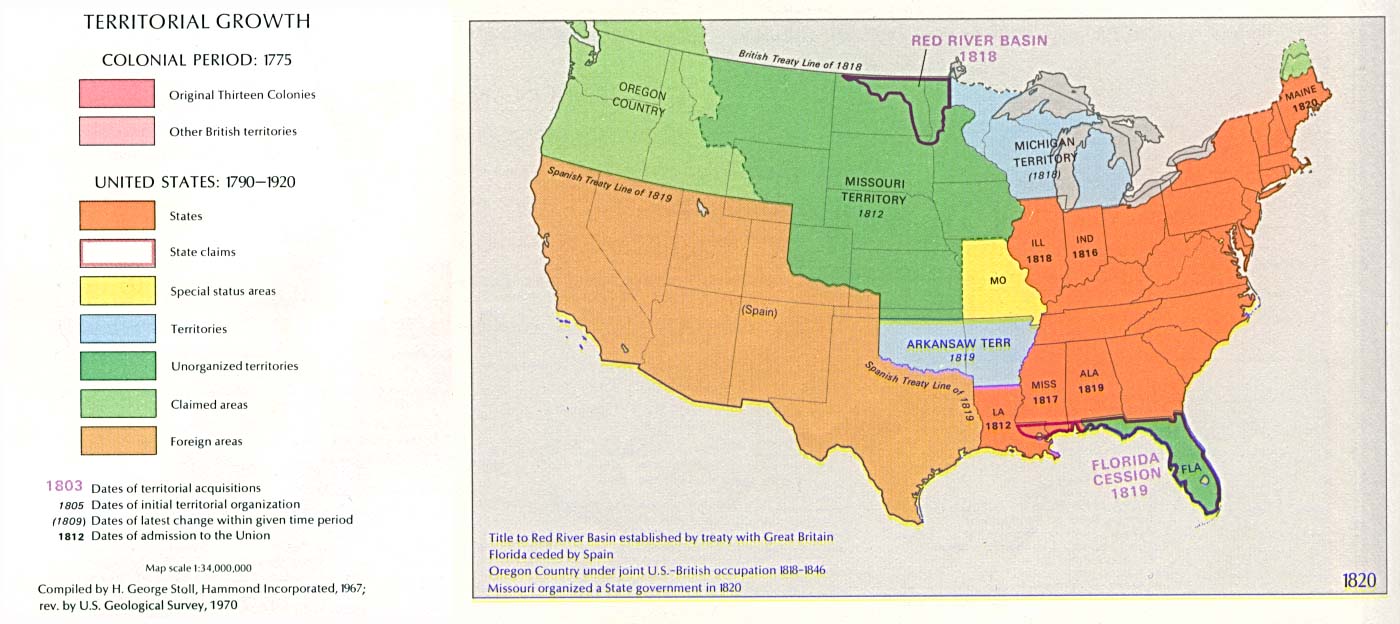
The USA also wanted a large chunk of land west of the Mississippi that was controlled by Spain and/or Mexico. This needed to be taken at gunpoint since Mexico didn't want to give up its land any more than the USA would be willing today to sell California back to Mexico.

(click on map to zoom. The whole southwest needed to be "taken" to meet the USA's goal of reaching both oceans.
http://www.lib.utexas.edu/maps/united_states/us_terr_1820.jpg )

As well, large sections of Central and South American "needed" by be exploited by the USA, goods taken, and opposition forces jailed or killed. That wasn't a very pretty picture, and, again, the population was demonized, dehumanized, and a new image painted for Americans of Hispanics and Mexicans as backwards, deservedly poor, lazy, illegal, criminal, interested in mooching, etc.

While people participated in creating that myth, to a large extent it was a system action that used this myth to justify what it wanted to do anyway -- take the land and exploit the people.

So, getting normative here, I think it's our job to recognize when groups are becoming targets of such increasing myths, and dispel them before they grow so strong that violent action results. It's important to realize that these thoughts are not our own thoughts or experience, but are being selectively reverberated by "systems effects."

As with the poverty ghetto, these thoughts can be caught up in a self-reinforcing positive feedback loop, that begins to "pile on" confirming evidence to justify that view, while conveniently and increasingly ignoring contrary evidence, until even our own personal entire experience becomes doubted. At that point, we fall into enslaving populations (as with African Americans) or exterminating them wholesale (as the Germans were doing to the Jews.)

And, again, as with ghetto formation, this effect appears to be a self-constructing web that requires no "spider". Certainly, some politicos will "ride this" and pour gasoline on the flames if they think it will bring them personal success, but that is more a reinforcing symptom than a "cause." Politicians couldn't amplify this effect if it wasn't already in motion.

Our job is to debunk such myths, recognize that these are someone else's thoughts, not our own, and return to sanity and common sense and trusting our own experience in the period prior to the call going out to rally the troops against the menacing advancing horde of Hispanics who plan to eat our children. It's too bad the broad-brush category even exists to justify a "them" versus "us" lumping -- without it we'd say - Oh, Mary and Rafael and their kids? What a nice family! Let's have them over for a barbecue on Saturday and maybe we can play some soccer or baseball or something.


xx

Tuesday, August 07, 2007

Nancy Krieger's Spider located? Response to Putnam

I was pondering Harvard researcher Nancy Krieger's question about reconciling apparent signs of a conspiracy to exploit the poor with lack of any actual suspects. Admittedly, in the Tobacco industry, there was an actual conspiracy, but it wasn't "directed" at blacks or the poor in an evil way -- they just "happened" to be easy victims. How does that happen?

( ref: Krieger N. Epidemiology and the web of causation: has anyone seen the spider? Soc Sci Med, 1994, 39:887-903.)

I think the answer may lie in the nature of systems thinking and feedback loops. As I've discussed, even the simplest goal-seeking feedback loop acts as if it has a mind of its own, and is a sort of "proto-life", or "MAWBA" - (Might As Well Be Alive.) of a more fundamental nature than even cells or DNA. This is the core of silicon life forms as well, or any system of any material that is adaptive and cybernetic.

All we need to explain the observed concentration of exploitation on poverty-laden areas is a single feedback loop and minimal dynamics. Here's the causal loop:


And the dynamics are similar to the charge build-up that precedes a lightning stroke:


Any "pressure" acts almost alive, as if it is consciously seeking a way out, probing every weakness. Once it finds even a tiny gap, as with the over-topping the levees in New Orleans, positive feedback enlarges the hole and momentum builds up flowing towards that hole.

Catastrophe ensures, both mathematically and physically, or in our case, socially. In fact, in the weather case, the addition of the Coriolis force can create a tornado or hurricane that even feeds on energy in the environment and grows larger and stronger.

So, we don't actually need a "conspiracy" - we just need pressure and a situation where weakness is exploited and exploitation leads to weakness, which leads to more exploitation, which leads to more weakness, etc. in an exponentially increasing cascade.

With active corporate MBA's looking to see what other corporations are doing, once one starts making money exploiting the poor, others rush to follow suit, attracting still others, etc.

My suspicion is that the relationship that Robert Putnam has found between diversity and a loss of social capital
Robert D. Putnam (2007), E Pluribus Unum: Diversity and Community in the Twenty-first Century The 2006 Johan Skytte Prize Lecture
Scandinavian Political Studies 30 (2), 137–174.
is actually a reflection of the fact that the above-mentioned feedback loop differentially focuses exploitation on the poor, making them poorer, which induces more exploitation, etc. The end point of that Markov chain is death of the target population, I suppose, unless something else stops it sooner.

The key driver in making this catastrophe is collective willingness to exploit the weak for profit, and collective tolerance for this activity, probably based on a belief that this is "an unavoidable effect of free markets."

These earlier posts in this weblog are relevant for further reading:
E Pluribus Unum
Unity in Diversity is the central problem
Systems Explanations for Student Behavior
Being a Robot 101 - The Cybernetic Loop
Part A of Why Sloops Matter
Another gentle introduction to Control Loops
Causal Loop Diagrams, Stories and Macrobes
Systems Dynamics, Worcester Polytech and Social Policy

Wade