Individual depression may have a benefit to the herd. If so, it may be hard-wired into our genes nd our social structures that reflect our genes as a preserved trait, and that changes how to treat it.
All organisms and organizations need immune systems to detect invaders or parts of themselves that have gone astray, so they can be marked for removal and eliminated.
In the body, one troublesome situation is that some cells or pathogens may get off into a corner, or inside a bone, or up against a steel plate, where they are hard to be evaluated and attacked, so they multiply. Another may be that they no longer recognize the authority of the body, and go off on their own doing something else. But, evolution has come up with one clever solution to this problem - namely, apoptosis or "cell suicide."
If a cell is removed from active, productive, working connection with the body, it is programmed to kill itself. It doesn't need to be found by the body's police force - it finds itself. No castle or moat or steel wall or bone can protect it, because the destruct system is already built in.
It may be than that evolution has similarly built in an "auto-braking" system into human physiology, so that, when a human becomes disconnected from productive interaction with the social body, the human slows to a stop and then shuts himself down.
This results in resources flowing primarily to social members still able to act energetically and confidently. Over time, those who care about interactions with the social body end up dominating the scene. (sources of "altruism"?).
But, what's that model say about treatment of depression?
First, it says that depression is a symptom, not a cause - and so treating depression with drugs to "cure it", while immediately helpful personally, from the social body's perspective is a bad idea -- in that it means that socially discordant individuals will continue to act badly and absorb energy and resources, and, if left unchecked in large scale, eventually the social body will die from a loss of cohesion and trying to carry the burden of all this non-productive tissue.
Second, it would mean that "depression" is not, in fact, a pathology - it is a very healthy normal response of a subsystem of the social body to a disconnection event. From a social point of view, it's good. In fact, the whole terrorist "problem" and the corruption "problem" could be viewed as precisely a breakdown in such a system: people who have turned against the social body should, many people would assert, self-destruct so we don't have to go to the very hard work of trying to destroy them ourselves. That would be very efficient if they'd just get really really depressed, then suicidal. It would be way more efficient than trying to locate them in caves somewhere on earth.
But, it brings to focus a different problem. If we use that model, then why is it that we now are looking at 20 or 30% of the US population that is depressed? And, have all these people broken the connection with the social body, or did the social body break the connection with them, or both in some sort of vicious circle? It may be that the cost of health care is rising because the body of the public is, in fact, becoming unwell. And, again, this may be a symptom not a cause, and masking it with drugs would be "quackery" - treating symptoms while the disease grows worse.
Well, the work of Robert Putnam ("Bowling Alone") and the Duke study (mentioned in myprior post on depression) would seem to indicate that connections are, in fact, deteriorating and rather rapidly. That begs the question of why this is happening, or how.
One possible hypothesis would be that the culture of materialism and self-centeredness, sustained and amplified by television, is causing people one by one to abandon their concern for society and become increasingly self-oriented, which is triggering the hard-wired fatigue and depression responses. The trend towards "Me first" or "Only me, forget you, Jack" is evident and widely discussed in the media.
Another possible hypothesis is that, collectively, whole groups of people, such as the rich or middle class, have turned their backs on and abandoned the poor, the 45 million without health coverage, the jobless, etc. This could cut both ways, both by making the ones cut-off from social life become increasingly depressed or anxious, and by making those who are doing the cutting-off also depressed, because they are losing the other end of the social connection.
In other words, class-ism and racism ultimately do as much harm to the holder of the destructive bigotry as to the group on the receiving end -- it just takes longer. That would predict that even some of the very rich - say Britney Spears or Paris Hilton, would end up extraordinarily unhappy. That's not proof, but it illustrates the point. Britney lost custody of her children to get what? Another drink?
There is a long literature on the harmful effects on the rich and powerful of exploiting, or neglecting the poor and the [apparently] powerless. By this herd model, the powerless actually have their own protection built into the DNA of the powerful, where it can and will be triggered as the powerful cut ties to the powerless.
This is certainly a core lesson of many religions of the world. "Do unto others as you would have them do unto you." The model seems to say that no "enforcement by an angry God" is necessary in fact - that the downstream result of the action of discrimination and superiority culture, both individually and overall, follows automatically from the action, and returns the favor, with interest.
So, if we boost the world, it will echo with amplification, and we will be boosted, and that becomes a self-climbing loop or spiral. If we cut off the links to the world, the world cuts off its links to us, which, surprisingly, we needed to continue to exist. If we actively exploit the outside world (think sub-prime mortgages) it will come back tremendously amplified and damage those who thought they could "get away with it."
This would imply that the same feedback mechanism and pattern might be true for cells, for individuals, for companies, and for entire nations or cultures.
For a company-sized organism, though, I've discussed the need for the "horizontal loop", the living feedback that Toyota calls "pull" that connects the company to the customers. Breaking this loop, as Comcast is described to be doing by many customers in today's Washington Post, may appear in the short run to be "working" and making more money than caring what customers think, but this model says that the resentment and social response is just building up steam and ultimately will come back with amplification.
It's a fairly simple model, but it seems to explain a lot of what we see going on around us. These "scale-invariant" patterns seem important to investigate to see if they hold up under more rigorous investigation. If so, we have some public policy and public health decisions we may want to rethink.
Religion and commerce (the Toyota Way) suggest the model, and system dynamics simulations show that some feedback with delay and amplification like this may be very hard to detect coming until it is too late. As with the Georges Bank model we ran in class, as the sustainable limit is passed and use turns into abuse, the fishing just seems to get better and better and the catch keeps rising as the fishermen build more boats until one day it is exhausted and it's simply over. We've depleted it entirely. The rising exponential plummets to zero.
There are almost no blatant clues this is happening. You have to understand what is going on to "see" it and realize it.
But it's up to Science now to take that suggested model and design careful experiments to test whether this is just an interesting analogy or the handle to some basic principle like gravity that we need to pay attention to. If the NIH or Business Roundtable won't fund it, maybe the John Templeton foundation will. Maybe a business "depression" bears more than a passing resemblance to a larger version of an individual "depresison."
Actually, MIT's John Sterman in his 1000 page textbook "Business Dynamics" lays out exactly how trying to push a company to grow too fast results in an apparent speed-up of profits, followed by a drop or crash, depending on exactly how it went. That implies that the villains of the corporate growth story are the stockholders themselves, from venture capitalists who demand 37% growth per year, to e-traders who chase the smallest fraction of a percent of a rate, punishing any CEO who pauses for breath or needed consolidation.
It also is a lesson for China, one that it is increasingly realizing, that growing too fast can be as much of a problem as not growing fast enough. Living things have natural growth rates, and we don't gain by trying to push them to do unnatural acts.
There's nothing wrong with wealth and prosperity, but vastly unequal and unjust accumulation of wealth by taking it instead of earning it does seem to lead to a "correction" that undoes all of the apparent progress and then some. Short-term greed is a very expensive pleasure, for it quickly becomes the long-run, and the bills come due. Without a deep keel, a culture and a social ethic that can hold off that temptation to maximize short-term gains, we can easily be led astray.
It's time to fund that research and let the data speak for itself. A reasonable search for counter-examples and contrary evidence is required. All models are wrong but some models are useful - so maybe this has merit regardless.
Showing posts with label society. Show all posts
Showing posts with label society. Show all posts
Thursday, October 18, 2007


Friday, June 15, 2007
More on foreclosures - from the Baltimore Sun

The Baltimore Sun had a top front page story this morning
AT-RISK LOANS RISING IN STATE (in caps in the original)
by Jamie Smith Hopkins - 6/14/07
Here's some highlights
Geographic and socioeconomic distribution:
Rates in the suburbs are rising faster than in Baltimore, with defaults of pricey suburban homes, condo-conversion projects and even an undeveloped section of a new-home community in Harford County - which went back to the lenders at an auction this week.... loan problems are particularly focused in a handful of states, ones with persistent job losses - Ohio, Indiana and Michigan - and ones that had a lot of real estate speculation, including California and Florida.Trend:The number of homes in the foreclosure process in Ohio, Indiana and Michigan is so high that together the three states account for about 20 percent of all U.S. foreclosures. Ohio tops the country, its share of homes in the foreclosure process more than six times Maryland's. [ note - this is big-3 auto industry downsizing effect]
I think there is a clear indication that the number of foreclosures is only going to increase," said Phillip R. Robinson, executive director of Civil Justice Inc., a Baltimore legal-help group. "The concern that I have as a public-interest advocate is, what do we do to help people in that pipeline save their home ... and how do we prevent people from getting into inappropriate loans?" [ emphasis added]Root cause and solutions:
Now, I find it interesting that the "solutions" to this problem all seem to involve some kind of governmental legal or policy action.
One "solution" in Maryland and elsewhere is to use taxpayer money to bail out those in trouble and, well, reward those who got this whole thing rolling in the first place which, one might think, would only reinforce that behavior in the future. ("unintended consequence"?)
The state said this week it has commitments for $100 million to refinance Maryland homeowners from such ARMs into fixed-rate mortgages so borrowers aren't overwhelmed. "We're going to stand up ... to protect that building block of wealth for the middle class that is homeownership," Gov. Martin O'Malley said as he announced the initiative.Another "solution" involves "going after" those people who oversold these loans in the first place, people who say in self defense "why blame us?" Congressmen are threatening to change which agency "regulates" such loans if much stronger rules are not put in place to "bring this under control." [ Hmm... sounds like a regulatory feedback process to me...]
What is, to me, conspicuously absent from those solutions is raising the effective economic IQ of the people who fell for this very bad idea in the first place.
Trying to "regulate" this once it's at full throttle is like trying to control the flow of smoke with huge billboards, instead of putting out the fire.

We keep trying to come up with "foolproof" ways to, well, make life safe for fools. It's very expensive, and it doesn't work very well, if at all. It also results in being a real pain for those who were responsible in the first place, who end up bearing the costs for those who were irresponsible.
But the irresponsible claim immunity on account of stupidity. "The car was going so fast that there was nothing I could do to stop on the ice! It's not my fault!"
Right. And media feed this concept. I bounce off the walls every time I see headlines like "ice causes pileup on freeway" or "fog causes 27 car crash - 5 dead."
In aviation, there is no such thing as a crash caused by "bad weather." There is "a decision to continue operations into weather beyond the skill and experience of the pilot." This gets back to people. To us.
In my mind, that's what needs to be fixed. We need to overcome collective stupidity and greed, by changing the story, and working together, and trying to have a group IQ that is at least as large as the largest individual IQ among us, if not larger.
That used to be one of the points of civilization, literature, history, science, and government.
We've abandoned that in favor of downstream damage-control efforts, the same way our health care system focuses money on heroic repair instead of prevention.
Curious. Why do we do that?
------- post script
I wanted to clarify one point. I'm not saying that people as individuals are stupid, but that the way we're interacting and interconnected (or not) is what's stupid and what's broken.
This is why understanding that basic concept about "systems" is so critical, or we can't even begin to see "where" this is broken. The problem isn't with what's between our ears, because humans are pretty smart animals. The problem is at a different "level".
There are "levels" and each one has properties that are mostly independent in the short run from other levels. I'm talking about a "systems" problem in that the way otherwise-smart people INTERACT and INTERCONNECT is what's broken here.
And therefore, that's what needs to be "fixed."
This is not a problem that just affects "dumb" people, or that has anything to do with native intelligence. This happens to doctors, scientists, airline pilots, CEO's. There's even a book called "Why do smart people do dumb things?"or some similar title. Individuals can make just a little indent to try to keep order around themselves, and this can be totally undone by a larger tilt to the playing field on a neighborhood or cultural level.
In the short run, "gangs" or groups of teenagers go off and do things that are incredibly stupid that are almost incomprehensible and that no single one of them would have done if left to himself. There's a "group effect." It can be for the good, or for the bad - it's neutral.

(Picture from my post on The Toyota Way viewed as feedback control).
For high-reliabilty, critical operations, like an Intensive Care Unit, or an aircraft cockpit,
or a nuclear reactor control room, literature shows that you can't get the results you need unless both levels are engaged and working well - the individual level and the group / team level. Individuals aren't strong enough to manage alone, regardless how bright they are.
Bryan Sextan presented data that 74% of commercial airline accidents happened on the very first day a new team of people was formed out of people that used to be on other teams. The pilots are still 20,000 hour professionals, but the "TEAM" has not yet gelled, and that leave a gap between levels that the accident can leak through.
(See my clever cartoons on accidents leaking through "swiss cheese" that's not well interconnected here in "The road to Error" ).
Loose people are like "dust in the wind" and can be blown anywhere. Interconnected people are like mountains and can defy the wind.
In that metaphor, I'm less interested in "reimbursing the dust" than I am in understanding why the mountain has turned to dust, and whether that is reversible, and if so, how and when can we start?
Saturday, December 02, 2006
The importance of social relationships
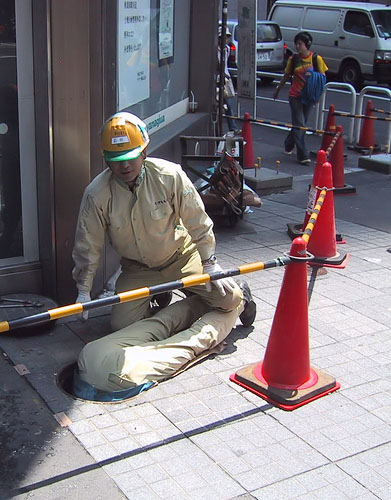
On the importance of relationships in the successful outcomes any kind of planning:
1) For a human to sustain peak performance, it is not enough to engage the brain; we have to engage the heart.
2) We're very social animals, always watching each other for clues; to sustain a value, we need to see constant reaffirmation from others that it is still a value today.
3) We are each other's context, and have to proactively make an effort daily to give that reaffirmation of our shared values and positive feedback/encouragement for the right thing, not just criticism of the wrong thing.
4) Sustaining that shared spirit is what makes the daily pain tolerable; to paraphrase old wisdom: the spirit can survive any illness, but a broken spirit - who can bear?
5) The side-conversation of any "business" decision has to be a human conversation that says: "We share a goal, we share these values. I really like you. Now, what was it we were arguing over and deciding?"
6) If it doesn't have a spirit, create one; if it has a Spirit, treat that as if it were a living being, with its own "health" and "fitness," and make sure that there's a program to keep it healthy.
1) For a human to sustain peak performance, it is not enough to engage the brain; we have to engage the heart.
2) We're very social animals, always watching each other for clues; to sustain a value, we need to see constant reaffirmation from others that it is still a value today.
3) We are each other's context, and have to proactively make an effort daily to give that reaffirmation of our shared values and positive feedback/encouragement for the right thing, not just criticism of the wrong thing.
4) Sustaining that shared spirit is what makes the daily pain tolerable; to paraphrase old wisdom: the spirit can survive any illness, but a broken spirit - who can bear?
5) The side-conversation of any "business" decision has to be a human conversation that says: "We share a goal, we share these values. I really like you. Now, what was it we were arguing over and deciding?"
6) If it doesn't have a spirit, create one; if it has a Spirit, treat that as if it were a living being, with its own "health" and "fitness," and make sure that there's a program to keep it healthy.
7) Beware of solutions based on technology or "systems" that neglect compassion. Compassion is the strongest suit there is, the strength to build on - "He ain't heavy, Father, he's my brother."
The "caring" in "health care" is what makes it work. Not caring will kill any business model, cold. We don't build cars. We don't entertain. We care about people and do something about it. And that's what defines us and gets us up in the morning and holds us up 36 hours later.
8) Spiritual issues (above) have a dramatic impact on the bottom line, clinically and financially.
I see this daily in software design and performance outcomes our IT shop produces, something that at first looks 100% technical. People who care build things that survive. People who don't care build things that look similar but turn out to be a waste of time.
(photo by jarkkoS )
==========
technorati tags:POS, relationships, loneliness, depression, health, mentalhealth, connections, socialcapital, interactions, socialnetworks, networks, theoryY, impossible, DOE, rockyflats
Subscribe to:
Posts (Atom)